Totalling vs Totaling: Which Spelling Is Correct?
Totaling and totalling are two spellings of the same word — the -ing form of the verb “total,” meaning to add numbers to reach a final amount, or to damage a vehicle so badly that repair isn’t worth the cost.
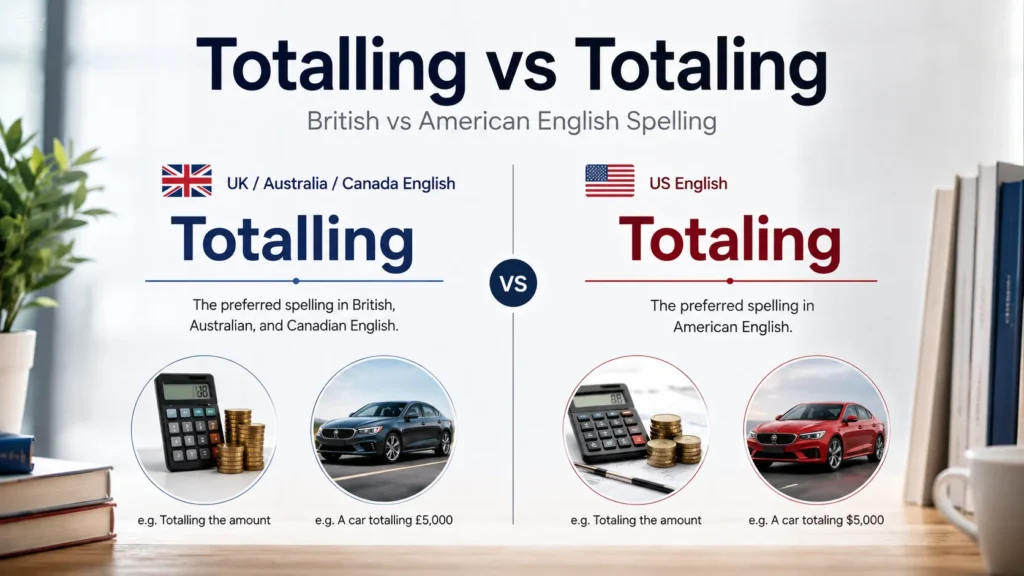
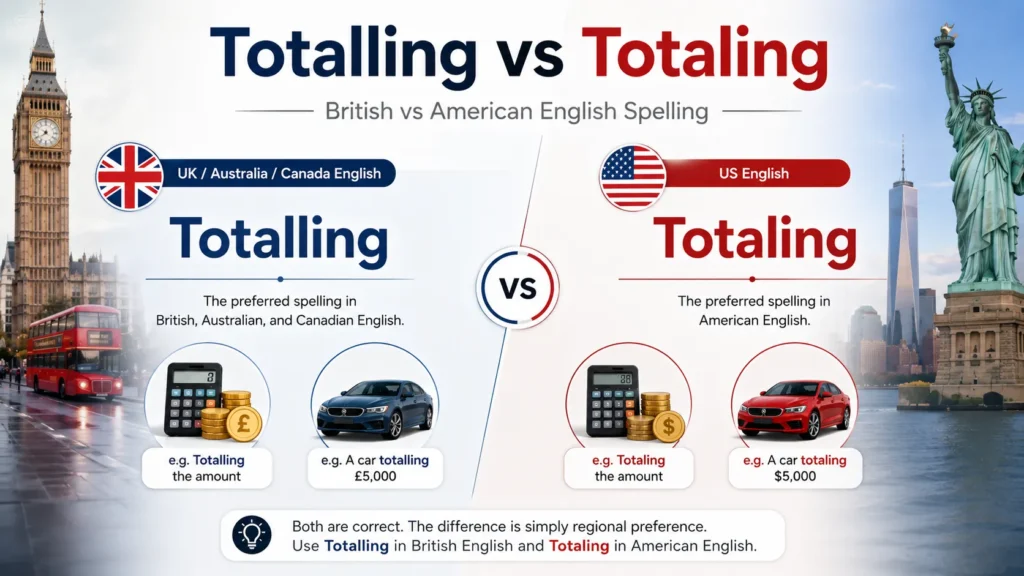
Totaling (one l) is standard American English. Totalling (two l‘s) is standard British, Australian, Canadian, and general Commonwealth English. Same meaning, same pronunciation — only the region changes which spelling is correct.
2. Quick Meaning Summary (Comparison Table)
| Totaling | Totalling | |
| Region | American English | British, Australian, Canadian, NZ English |
| Spelling | one l before -ing | two l‘s before -ing |
| Leading dictionary | Merriam-Webster | Oxford English Dictionary, Cambridge Dictionary |
| Style guide | AP Stylebook, Chicago Manual of Style | Oxford Style Manual |
| Example | “Expenses are totaling $4,000.” | “Expenses are totalling £4,000.” |
3. Origin and History of “Total”
Total entered English in the 1400s from the Latin adjective totalis, meaning “whole” or “entire,” by way of Old French. It functioned only as a noun and adjective for centuries.
The verb sense — “to total,” meaning to add up or amount to — developed later.
4. Why Two Spellings Exist (The Doubling Rule Explained)
Both dialects follow a general spelling convention: double a final consonant before a vowel suffix if the last syllable is stressed — compare stop → stopping.
British English drops the stress condition specifically for words ending in l, doubling it regardless of stress. That’s why travel (stressed on the first syllable) still becomes travelling in the UK.
American English keeps the stress rule intact.
Neither version is “wrong” or inconsistent — they’re two different, internally logical applications of the same underlying rule.
5. Noah Webster and the American Spelling Reform
American English’s simplified spelling wasn’t accidental. Lexicographer Noah Webster deliberately trimmed a range of British spellings he considered unnecessarily complex in his early-1800s dictionaries and reform efforts.
That same push gave American English colour instead of colour, centre instead of centre, and traveled instead of travelled. Totaled/totaling followed the same pattern, becoming standardized in US dictionaries through the early-to-mid 20th century.
6. Why the Confusion Persists Today
Global content, international teams, and mixed-audience publishing mean both spellings appear side by side online constantly.
Most word processors also default to US English unless manually changed, which is why UK, Australian, and Canadian writers often see “totalling” flagged as an error even though it’s the correct spelling for their region.
7. Full Grammar Forms: Total, Totals, Totaled/Totalled
| Form | American English | British English |
| Base verb | total | total |
| -ing form (present participle/gerund) | totaling | totalling |
| -ed form (past tense/participle) | totaled | totalled |
| Third person singular | totals | totals |
| Noun (the sum) | total | total |
| Adjective (complete, whole) | total | total |
Only the -ing and -ed verb forms split by region. The noun and adjective total never change spelling — “the totalling” and “the totalling cost” are incorrect in any region; the correct forms are “the total” and “the total cost.”
8. Examples of Totaling and Totalling in Sentences
American English:
- The invoices are totaling $22,400.
- The accountant is totaling this quarter’s revenue.
- The crash ended up totaling the car.
- Refunds totaling $850 were sent.
British English:
- The invoices are totalling £22,400.
- The accountant is totalling this quarter’s revenue.
- The crash ended up totaling the car.
- Refunds totalling £850 were sent.
9. What Dictionaries and Style Guides Actually Say
- Merriam-Webster lists totaled/totaling as the primary American entries.
- Oxford English Dictionary and Cambridge Dictionary list totalled/totalling as standard British spelling.
- AP Stylebook and Chicago Manual of Style follow the single-l American form.
- Oxford Style Manual and UK newsroom guides (BBC, Guardian) use the double-l British form.
- Canada leans British (totalling) per the Canadian Oxford Dictionary, though totalling is understood due to US influence.
- Australia and New Zealand follow the British convention.
10. Is Totalling Correct in American English?
Not the standard form. Totalling isn’t a grammar error in the US, but it looks regionally inconsistent next to other American spellings like color, traveled, and canceled. US editors typically correct it to totaling.
11. Is Totaling Correct in British English?
Not the standard form. Totaling is understood in the UK, but it looks American beside British spellings like colour, travelled, and cancelled. UK, Australian, and NZ editors typically correct it to totalling.
12. Totaling a Car: The Insurance Meaning Explained
A car is “totaled” (US) or “totalled” (UK) when an insurer determines that repair costs equal or exceed a set percentage of the vehicle’s Actual Cash Value (ACV) — the total loss threshold, which varies by US state (commonly 70–100% of ACV). UK insurers use a comparable write-off category system (Category A, B, S, N under the ABI Code of Practice).
What that means in practice:
- You’re paid the car’s cash value, not the repair cost or remaining loan balance.
- If your loan exceeds the ACV, gap insurance covers the shortfall — standard auto insurance won’t.
- The vehicle typically receives a salvage title (US) or write-off category (UK), which affects resale value even after repair.
13. Common Mistakes to Avoid
- Mixing regional spellings in one document — e.g., “The colour-coded report shows expenses totaling £4,000.”
- Using it as a noun. The noun is total — “The total is $500,” not “The totaling is $500.”
- Using it as an adjective. The adjective is also total — “The total cost is $500,” not “The totaling cost is $500.”
- Trusting default spellcheck, which usually defaults to US English regardless of the writer’s region.
- Alternating spellings in international content instead of picking one house style and staying consistent.
14. Related Words With the Same US/UK Spelling Pattern
| Base Word | American | British |
| travel | traveling/traveled | travelling / travelled |
| cancel | canceling / canceled | cancelling / cancelled |
| label | labeling / labeled | labelling / labelled |
| model | modeling / modeled | modelling / modelled |
| signal | signaling / signaled | signalling / signalled |
| fuel | fueling / fueled | fuelling / fuelled |
If you remember the rule for one word in this list, it applies to all of them.
15. How to Remember Which Spelling to Use
- “US = shorter.” American English trims extra letters (color, center, traveled, totaling) — remember it as the streamlined spelling.
- Match a word you already default to. If you write travelling or cancelled, use totalling. If you write traveling or canceled, use totaling — the two families move together.
People Also Ask
Yes — it’s the standard British, Australian, Canadian, and Commonwealth spelling of the -ing form of “total.”
Yes — it’s the standard American English spelling of the same form.
They’re different grammatical forms, not variants of each other: totaled is the American past tense, while totalling is the British present participle. Their direct counterparts are totalled (British past tense) and totaling (American present participle)
Canadian English generally leans toward totalling, following British convention, though totaling is understood due to US influence.
Not a grammar error, but it reads as regionally inconsistent — editors in either region typically correct it to match local convention.
.
It means an insurer determined that repairing the vehicle costs more than a set percentage of its actual cash value, making a payout more economical than repair.
It depends on how you count: American English dominates by single-country population, but British-style spelling is used across more individual countries (UK, Australia, Canada, NZ, India, and most of the Commonwealth).
Conclusion
Both totaling and totalling are correct — the only variable is which English you’re writing for. American English drops the second l (totaling, totalled), while British, Australian, Canadian, and Commonwealth English keep it (totalling, totalled). The difference comes from a subtle variation in how each dialect applies the final-consonant-doubling rule, not from any error or inconsistency. Match your spelling to your audience, keep it consistent with the rest of your document’s regional conventions, and you’ll never have to second-guess this one again.