
Reevaluation or Re-evaluation? The Correct Spelling, Explained
If you’ve typed this word twice and it looked wrong both times, you’re not alone — reevaluation is one of the most commonly double-checked spellings in English, precisely because the prefix “re-” collides with a word that also starts with “e.”
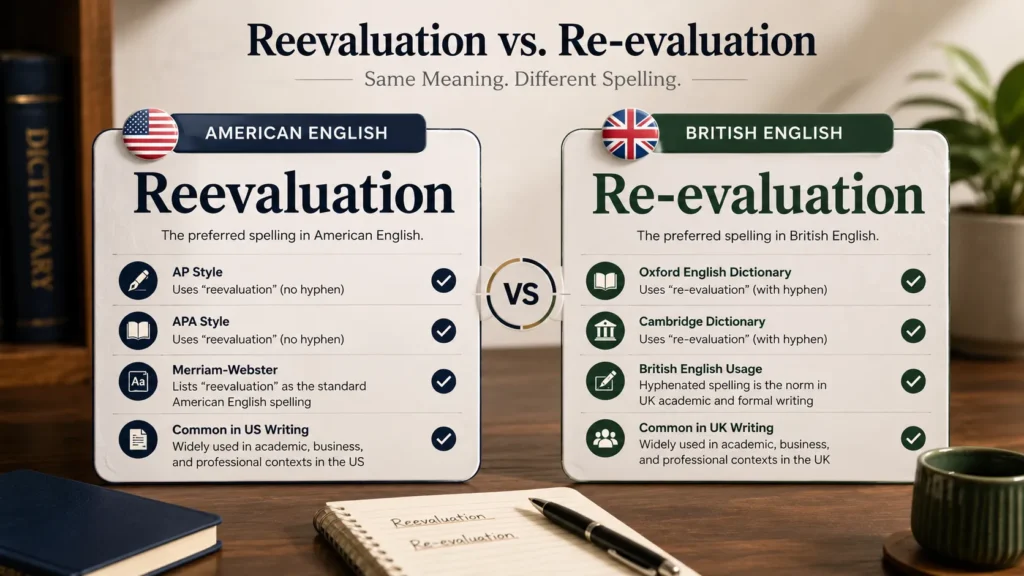
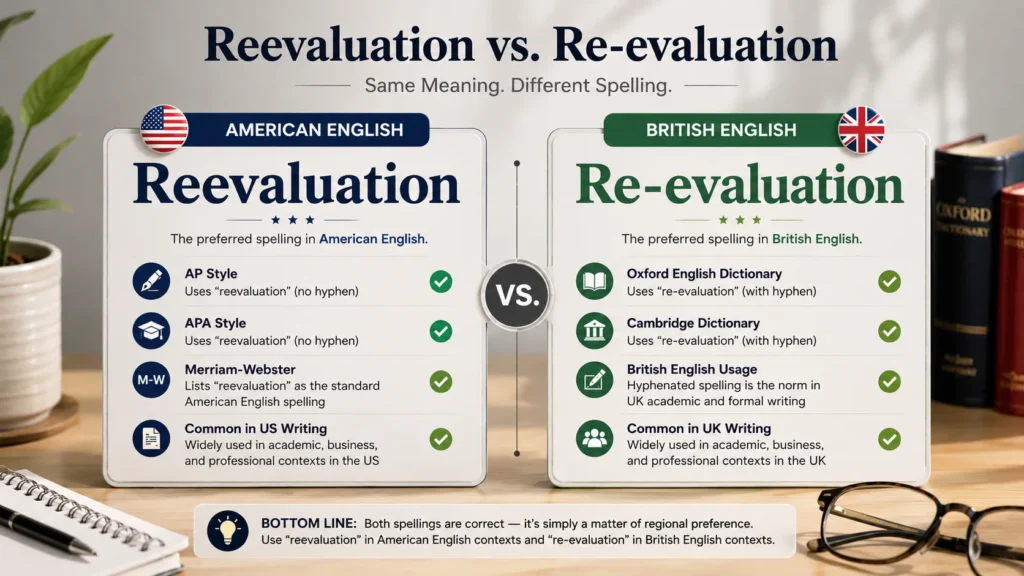
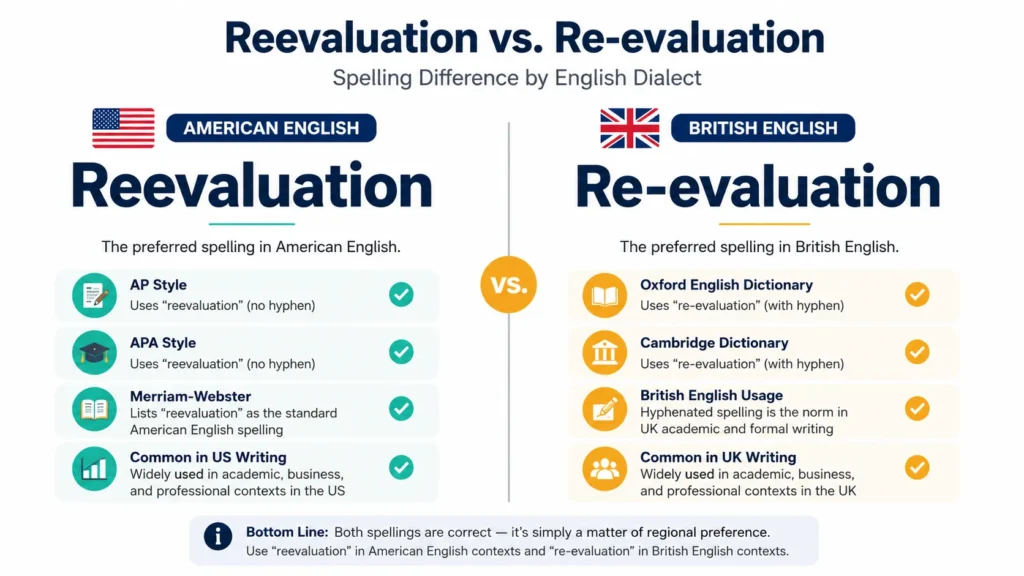
Short Answer: Both “Reevaluation” And “Re-Evaluation” Are Correct. “Reevaluation” is standard American English — used by AP Style, APA Style, and Merriam-Webster. “Re-evaluation” is standard British and Commonwealth English. The meaning is identical in both; the difference is regional style, not grammar.
1. What Does “Reevaluation” Mean?
Reevaluation is a noun meaning the act of assessing, judging, or reviewing something again — usually because new information or a change in circumstances has come up since the original assessment.
It breaks down into:
- re- — “again”
- evaluate — “to judge the value, quality, or condition of something”
- -ion — turns the verb into a noun
“The company ordered a reevaluation of its pricing strategy after losing three major clients.”
The verb form, reevaluate, works the same way (“We need to reevaluate our approach”).
2. Quick Meaning Summary
| Element | Detail |
| Word | Reevaluation / Re-evaluation |
| Part of speech | Noun (verb form: reevaluate / re-evaluate) |
| Core meaning | Assessing or judging something again |
| Correct spellings | Both — regional variants, not errors |
| American form | reevaluation (no hyphen) |
| British form | re-evaluation (hyphenated) |
| Never correct | “re evaluation” (space, no hyphen) |
| Commonly confused with | revaluation (a finance/currency term — different meaning) |
3. Origin of the Word
“Evaluate” entered English in the early 1900s from the French évaluer (“to find the value of”), itself rooted in Latin — “out” (e-) plus “value” (valere, “to be strong/worth”). Once “evaluate” and “evaluation” were established, adding the productive prefix re- (“again,” from Latin) to form “reevaluate”/”reevaluation” followed the same natural pattern that gives English rewrite, reconsider, and reassess. There’s no separate etymology for the hyphenated form — it’s the same word, styled differently by region.
4. Reevaluation or Re-evaluation: Which Is More Common?
| American English | British / Commonwealth English | |
| Standard spelling | reevaluation | re-evaluation |
| Backed by | AP Style, APA Style, Merriam-Webster | Oxford Dictionary, Cambridge Dictionary |
| Typical publishing usage | Dominant form in US content and journals | Standard in UK press, government, academic writing |
| Example | “The board approved a reevaluation of the merger.” | “The board approved a re-evaluation of the merger.” |
Neither spelling is objectively “more correct” — it’s regional, the same way organize/organise or color/colour is regional. Globally, the closed (no-hyphen) form appears more often online simply because American English dominates web content volume
5. The Rule Behind the Hyphen
This isn’t unique to “reevaluation” — it’s part of a general pattern for how English handles the re- prefix when it meets a word starting with the same vowel.
Vowel collision (re- + e, re- + o): Modern American style typically closes the word up, no hyphen — reevaluate, reelect, reenter, reengage, reemerge. Some style guides and older UK-influenced texts still hyphenate these for readability (re-enter, re-election) — both are accepted.
Hyphenate only when it changes the meaning: the one hyphen rule every style guide agrees is mandatory, because skipping it creates a different, real word:
- re-cover (cover again) vs. recover (get better)
- re-sign (sign again) vs. resign (quit)
- re-creation (create again) vs. recreation (leisure)
“Reevaluation” has no such competing word, so the hyphen there is optional, never mandatory. When unsure, check a dictionary, not autocorrect — Merriam-Webster’s main entry is the closed form (“reevaluate”), with “re-evaluate” listed as an accepted variant.
6. What the Major Style Guides Say
| Style Guide | Preferred Form | Why |
| AP Style | reevaluation | Follows Merriam-Webster; drops hyphens after “re-” unless needed to avoid confusion with another word |
| APA Style (7th ed.) | reevaluation | Consistently used across APA-published research and its own prefix guidance |
| Chicago Manual of Style | reevaluation | Favors closed compounds once established; hyphen permitted only for clarity |
| MLA | No fixed rule | Defers to a standard dictionary — reevaluation is the safer default |
| Merriam-Webster (US) | reevaluation | Main entry; “re-evaluate” listed as a valid variant |
| Oxford / Cambridge (UK) | re-evaluation | Standard British hyphenation before a vowel-initial root |
Default to reevaluation for US audiences and any style guide that doesn’t specify otherwise. Use re-evaluation for UK/Commonwealth audiences, or wherever house style requires it.
7. Reevaluate or Re-evaluate? (Verb Form)
Same logic, same answer:
- Reevaluate — American standard: “We need to reevaluate our pricing strategy.”
- Re-evaluate — British standard, and still common in American formal/legal writing for clarity: “The board voted to re-evaluate the merger terms.”
Both conjugate normally: reevaluate, reevaluates, reevaluated, reevaluating (or the hyphenated equivalents).
8. Reevaluation vs. Revaluation
This is the one spot where getting it wrong changes the meaning, not just the style.
| Word | Meaning | Typical field |
| Reevaluation / re-evaluation | Reassessing something in general — a decision, condition, plan, or performance | General, medical, business, education |
| Revaluation | Officially adjusting the stated value of a currency, asset, or property | Finance, economics, real estate, taxation |
❌ “The central bank announced a reevaluation of the currency.” ✅ “The central bank announced a revaluation of the currency.”
❌ “HR completed a revaluation of the employee’s performance.” ✅ “HR completed a reevaluation of the employee’s performance.”
If the subject is money, currency, or asset/property value → revaluation. If the subject is a decision, condition, or judgment → reevaluation.
9. Examples of Reevaluation in a Sentence
- “After the audit, Leadership called for a full reevaluation of the budget.”
- “The therapist recommended a reevaluation of her treatment plan after six weeks.”
- “Following the sales dip, the board initiated a reevaluation of the marketing strategy.”
- “The court ordered a re-evaluation of the evidence before sentencing.” (hyphen retained for legal clarity)
- “Please allow two to three weeks for the re-evaluation process to complete.” (UK/formal usage)
10. How the Word Is Used in Different Fields
Special education (IEP / IDEA): Under the US Individuals with Disabilities Education Act, “reevaluation” is a defined legal term — any assessment of a student happening after the initial evaluation counts as a reevaluation. Schools typically must conduct one at least every three years; parents can request one earlier. Education and IEP documentation consistently uses the closed, no-hyphen form.
Medical/clinical use: Clinicians “reevaluate” a patient’s condition, diagnosis, or treatment response, often at scheduled follow-ups. US medical documentation almost universally uses “reevaluation.”
Business and finance: In business writing, “reevaluation” reassesses a strategy, budget, timeline, or vendor relationship — not a monetary value (that’s revaluation).
Legal and government writing: The hyphen survives more often here, even in American English, because legal drafting prioritizes zero ambiguity over brevity.
11. Common Misunderstandings
- “One of them must be wrong.” No — both are correct, standardized spellings; the difference is regional, like organize/organise.
- “The hyphen changes the meaning.” It doesn’t, for this word specifically. (It does for lookalikes like re-cover vs. recover.)
- “Reevaluation and revaluation are interchangeable.” They’re not — revaluation is a finance/currency-specific term.
- “Spellcheck flagging ‘reevaluation’ means it’s wrong.” Some spellcheckers flag the double vowel and suggest the hyphen as a “fix” — that’s a style suggestion, not a grammar correction.
12. Related Terms and Similar Meanings
- Reassessment — near-synonym, slightly more common in policy/education contexts
- Review — broader, less formal synonym
- Reappraisal — near-synonym, common in valuation and performance contexts
- Revaluation — related but distinct (currency/asset value)
- Re-examination — near-synonym, common in legal/medical contexts
13. Quick Decision Checklist
- Writing for a US audience? → Use reevaluation.
- Writing for UK/Commonwealth audience? → Use re-evaluation.
- Have a house style guide? → Follow it; it overrides general convention.
- Talking about currency, an asset, or property value? → You mean revaluation, not reevaluation.
- Already used one spelling earlier in the document? → Keep using that same one.
- Still unsure? → Default to reevaluation — the more widely used global form.
14. People Also Ask
One word in its standard American form. It’s never correctly written as two separate words with a space (“Re Evaluation”).
Reevaluation (no hyphen) is more common overall, mainly because American English dominates global digital content and it’s Merriam-Webster’s primary listed spelling.
No. AP Style follows Merriam-Webster and writes it as one word, “reevaluation.”
Q4 Is it wrong to use “re-evaluation” in American writing?
No. It’s grammatically correct everywhere — just less standard in the US. Some American legal and academic writing keeps the hyphen deliberately for clarity.
Reevaluation means reassessing something generally (a decision, plan, or condition). Revaluation specifically means officially adjusting the value of a currency, asset, or property. They aren’t interchangeable.
As a noun after a determiner or preposition: “The team conducted a reevaluation of the project,” or “This calls for a reevaluation of our approach.
15. Conclusion
Reevaluation and re-evaluation are both correct spellings of the same word — the choice comes down to regional convention (American vs. British English) or house style, not grammar. For US writing, default to Reevaluation, matching AP, APA, and Merriam-Webster. For UK or Commonwealth writing, use re-evaluation, matching Oxford and Cambridge. The only real rules to remember: never write it as two separate words, don’t confuse it with the finance term revaluation, and once you pick a spelling, stay consistent throughout your document.