Google Meaning: What Does Google Mean? Definition, Origin & Uses
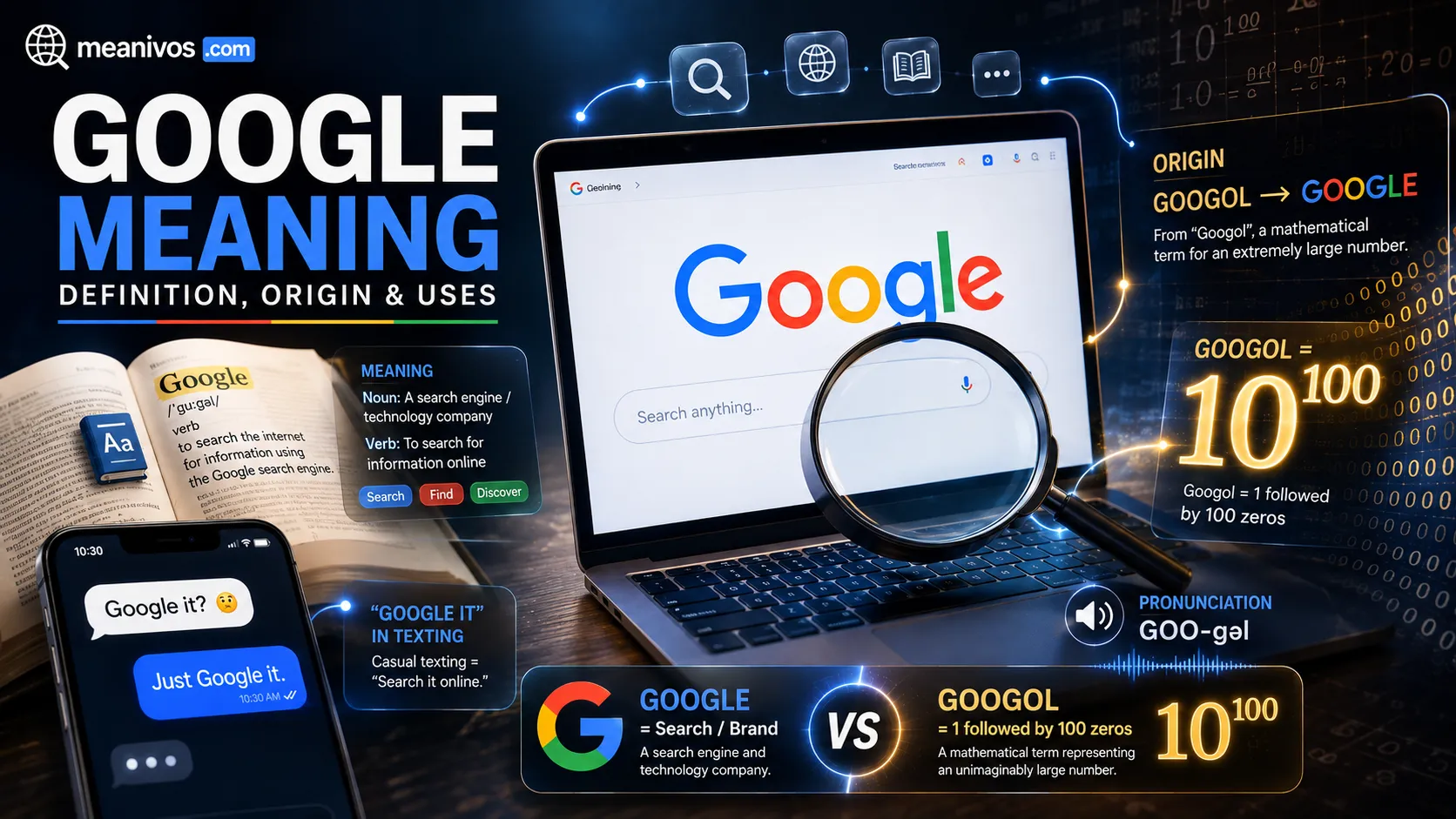
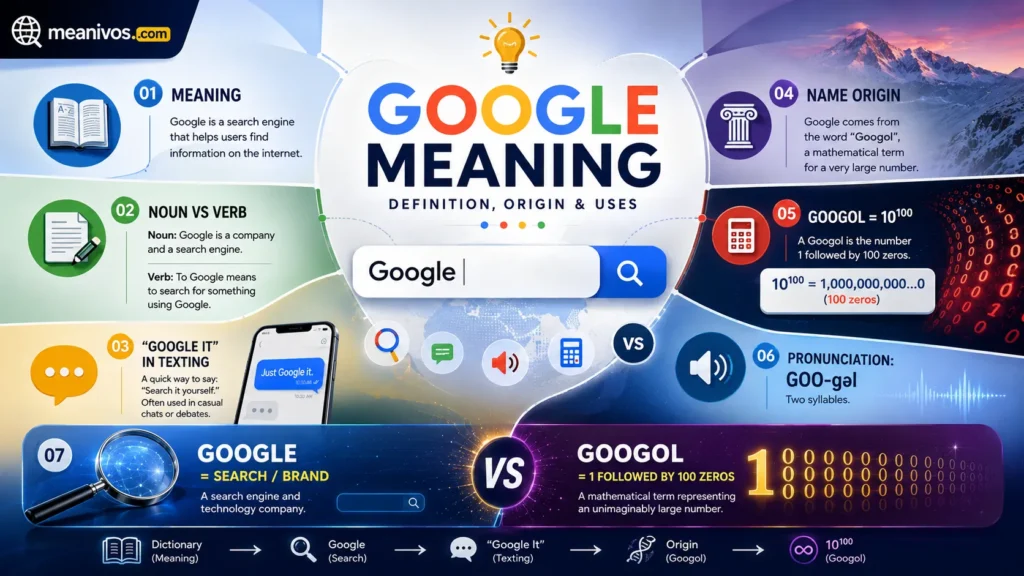
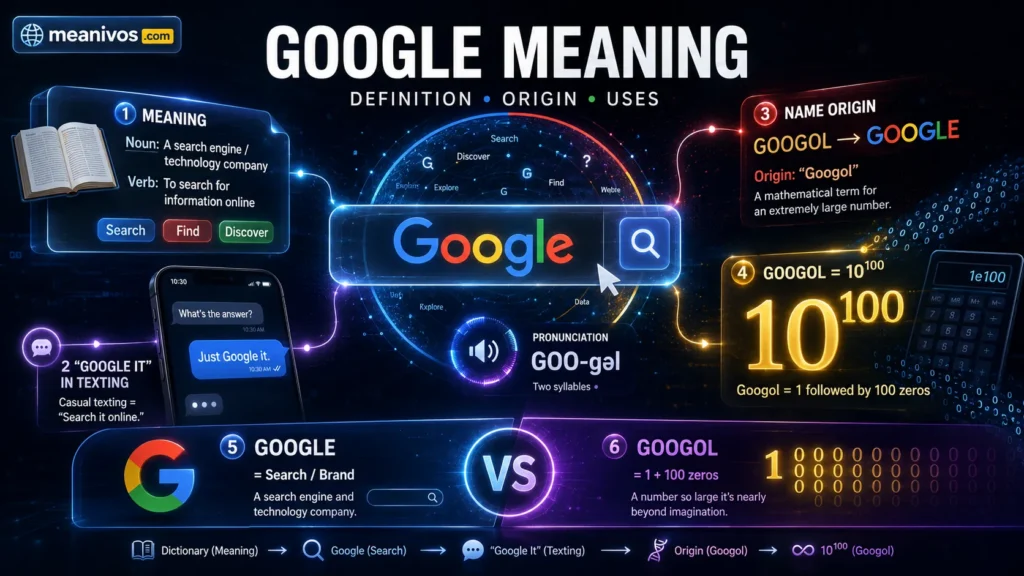
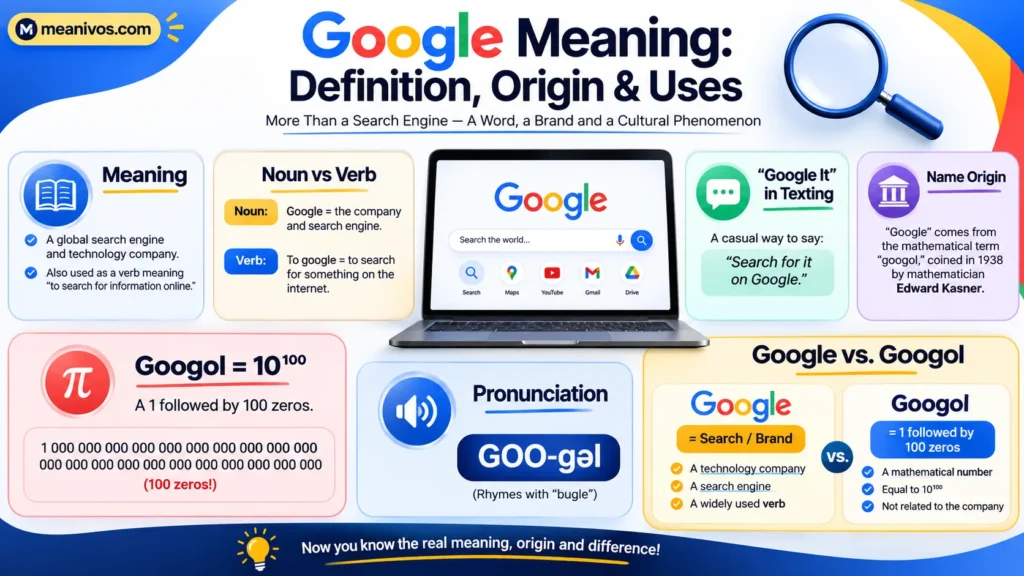
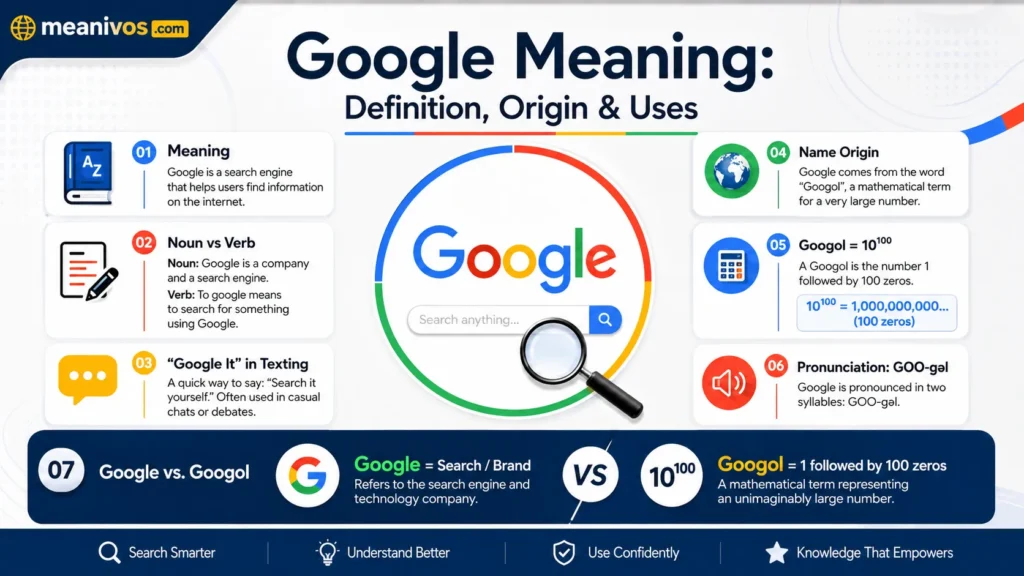
If you are searching for the Google Meaning, you may simply want to know what the word means. The short answer is that Google is the name of a well-known internet search engine and technology brand. As a verb, to google means to search for information online using Google Search.
But the word has an interesting history.
The name Google was inspired by googol, the mathematical name for the number 10¹⁰⁰, or 1 followed by 100 zeros. Google’s own history explains that the name was a play on this enormous number and suited the founders’ ambition to organise a huge amount of information.
Today, Google is used not only as a company or search-engine name but also as an everyday English verb. Expressions such as “Google it”, “I Googled it”, and “Have you Googled that?” are common in informal conversation.
This guide explains the Google meaning, definition, origin, pronunciation, grammar, texting usage, examples, and the important difference between Google and googol.
What Does Google Mean?
Google is the name of a popular internet search engine and technology brand.
The word also has a verb form:
to google = to search for information online using Google Search
For example:
- “I found the answer on Google.”
- “I’ll Google the address.”
- “Just Google it.”
- “She Googled the restaurant before visiting.”
Cambridge Dictionary recognises Google as the name of a search engine and google as a verb meaning to search for something on the internet using Google.
Quick answer
| Question | Answer |
| What does Google mean? | A search engine/technology brand |
| What does Google mean as a verb? | To search online using Google |
| What does “Google it” mean? | Look it up online |
| Where does the name come from? | The mathematical word googol |
| What is a googol? | 10¹⁰⁰, or 1 followed by 100 zeros |
| Is Google an acronym? | No, its established name origin is linked to googol |
| Is Google a noun or verb? | It can be either, depending on usage |
Google Meaning in Simple Words
In simple English:
Google = a search engine, or the act of searching online with Google.
The exact meaning depends on how the word appears in a sentence.
Google as a noun
When Google refers to the company, brand, or search engine, it functions as a proper noun.
Example:
“I found the information on Google.”
Here, Google is the name of the search service.
Another example:
“Google is one of the world’s best-known technology brands.”
Google as a verb
When Google describes the action of searching online, it is a verb.
Example:
“I googled the answer.”
This means:
“I searched online for the answer using Google.”
Merriam-Webster lists Google as a verb and defines it as using the Google search engine to obtain information on the internet.
Easy rule to remember
Google = the name
google = the action
This distinction is especially useful when writing English correctly.
Google Definition in English
Major English dictionaries recognise the word’s modern uses.
Cambridge defines Google as the name of a search engine and google as a verb for searching for information online using Google.
Merriam-Webster lists google as a transitive verb meaning to use the Google search engine to obtain information about someone or something on the internet.
Oxford Learner’s Dictionaries also lists Google as a verb meaning to type words into Google to find information about someone or something.
Short dictionary-style definition
google (verb): To search for information online using Google Search.
Is Google a Noun or a Verb?
It can be both.
The grammatical role depends on the sentence.
Google as a noun
“I searched Google for the answer.”
“Google is my preferred search engine.”
“The information appeared in Google Search.”
In each case, Google identifies the search service or brand.
Google as a verb
“I’ll google the address.”
“She googled his name.”
“We googled the restaurant before booking.”
Here, google describes an action.
Oxford gives forms such as google, googles, googled, and googling.
Verb forms
| Form | Example |
| Present | I google the answer. |
| Third person | She googles the address. |
| Past | He googled the restaurant. |
| -ing form | They are googling the information. |
Merriam-Webster gives the first known use of the verb in 2000.
What Does “To Google” Mean?
To Google something means to search for information about it online, especially by using Google Search.
For example:
“I’ll Google the opening hours.”
This means:
“I’ll search online to find the opening hours.”
You can Google:
- a person’s name
- a location
- a recipe
- a word
- a definition
- a company
- a product
- a restaurant
- an address
- a historical fact
- a question
More examples
“Google the address before you leave.”
“I Googled the word because I wasn’t sure how to spell it.”
“She googled the company before applying for the job.”
“We need to Google the train times.”
The expression is now deeply established in everyday English. Merriam-Webster’s current examples also show Google being used naturally as a verb.
Google Meaning in Texting and Social Media
When someone writes “Google it” in a text message, WhatsApp conversation, comment, or social-media discussion, they normally mean:
“Search for it online.”
It is usually an informal instruction rather than a special secret slang term.
Example 1
Person A: What time does the shop close?
Person B: Google it.
Meaning: Search online to find out.
Example 2
Person A: What does this word mean?
Person B: Just Google it.
Meaning: Look up the definition online.
Example 3
Person A: Who is that actor?
Person B: Google his name.
Meaning: Search online for information about him.
Is “Google it” slang?
Not primarily.
Google is a brand name, while “Google it” is an informal everyday expression based on the verb google. Slang.net similarly describes “Google” as an informal term associated with searching the internet.
So if you see:
“Google it.”
The simplest interpretation is:
“Look it up online.”
What Does Google Mean in Different Contexts?
The word can have slightly different practical meanings depending on context.
| Context | Meaning |
| Technology | Google search engine/company |
| Dictionary | Noun and verb |
| Texting | Search for it online |
| Social media | Look it up/check online |
| Education | Find information online |
| Workplace | Search for information |
| Casual conversation | Look something up |
| History | Brand name inspired by googol |
This broader context explains why the query “Google meaning” cannot be fully answered with only “Google is a search engine.”
Where Did the Name Google Come From?
The name Google comes from the mathematical term googol.
A googol is:
10¹⁰⁰
In simple terms, that means:
1 followed by 100 zeros.
Google’s official history says Larry Page and Sergey Brin initially developed a search engine called BackRub while working at Stanford. The project was later renamed Google. Google describes the new name as a play on the mathematical expression for 1 followed by 100 zeros and connects it with the founders’ goal of organising the world’s information and making it universally accessible and useful.
This is the established explanation for the company’s name.
Why was the name appropriate?
A googol is an unimaginably large number.
The founders were building a system intended to deal with an enormous amount of information on the expanding World Wide Web.
The name therefore suggested scale and vast quantities of information.
What Is a Googol?
A googol is a mathematical number equal to:
10¹⁰⁰
It is:
1 + 100 zeros
The word googol was coined in the 20th century for this extremely large number.
It is important not to confuse it with Google.
Google vs. googol
| Word | Meaning | Example |
| Search engine/technology brand | “Search it on Google.” | |
| Search online using Google | “I’ll google it.” | |
| googol | 10¹⁰⁰ | “A googol is a huge number.” |
| Googleplex | Google’s headquarters name | “The Googleplex is in Mountain View.” |
| googolplex | A mathematical number far larger than a googol | “A googolplex is enormous.” |
Merriam-Webster specifically notes that Google and googol are commonly confused because of their similar pronunciation.
Easy memory trick
Remember:
googol = number
Google = search
That simple distinction prevents one of the most common mistakes involving the word.
Why Is Google Called Google?
Google was named after googol, the number 10 1 0 0.
Google’s official history states that the name was a play on the mathematical expression for 1 followed by 100 zeros.
The name fit the founders’ ambition to organise a vast amount of information.
The earlier search engine was called BackRub before the name was changed to Google.
The original research paper by Larry Page and Sergey Brin also explains that they chose the name because it was associated with googol and suited their goal of building a very large-scale search engine.
Why Was Google Originally Called BackRub?
Before Google became Google, its early search engine project was known as BackRub.
Larry Page and Sergey Brin developed the system at Stanford University. Its ranking approach placed significant importance on links between web pages.
Google’s official history confirms that the project was initially called BackRub before being renamed Google.
The name BackRub did not survive, but the underlying idea of using links to help understand the importance of web pages became an important part of the project’s development.
How Do You Pronounce Google?
Google is generally pronounced:
GOO-gəl
The Cambridge Dictionary gives the pronunciation as approximately /ˈɡuː.ɡəl/.
Oxford gives the pronunciation as approximately:
/ˈɡuːɡl/
Google vs. googol pronunciation
The two words sound similar, which can confuse.
- Google: GOO-gəl
- googol: GOO-gəl / GOO-gol, depending on pronunciation
The spelling and meanings are different even though the words are closely related in sound.
Google Examples in Sentences
Here are natural examples showing the different uses of Google.
as a noun
- I found the answer on Google.
- Google is a popular search engine.
- She searched Google for the restaurant.
- I used Google to find the address.
- The website appeared in Google Search.
- I’ll Google the address.
- She googled his name before the interview.
- I googled the recipe.
- They are googling the symptoms of the problem.
- He googled the meaning of the word.
- “What’s the answer?” — “Google it.”
- “Where is the restaurant?” — “I’ll Google it.”
- “What does this abbreviation mean?” — “Just Google it.”
Google vs. Search vs. Look Up vs. Research
These expressions are related, but they are not perfect synonyms.
Usually suggests searching with Google.
“I Googled the company.”
Search
A broader term for looking for information.
“I searched the website.”
Look up
Usually means finding a particular piece of information.
“I looked up the definition.”
Research
Usually suggests a deeper or more systematic investigation.
“I researched the history of the company.”
Quick comparison
| Word/Phrase | Typical meaning |
| Search using Google | |
| Search | Look for information |
| Look up | Find specific information |
| Research | Investigate a topic in greater depth |
So while someone may say “Google the answer”, they could also say “search for the answer” or “look up the answer.”
The wording changes slightly, but the basic goal is finding information.
Should “Google” Be Capitalised?
When you mean the Google brand or company, use a capital G:
“I found it on Google.”
When using google as the established verb, dictionaries commonly list the lowercase form:
“I googled the answer.”
Merriam-Webster lists the verb as google, with Google as a variant.
Oxford also treats google as a verb derived from the proprietary name Google.
Simple rule
Brand: Google
Verb: google
However, capitalisation can vary in informal writing, so the important point is understanding the grammatical distinction.
Is Google an Acronym?
No. Google is not a standard acronym.
You may encounter websites claiming that the letters G-O-O-G-L-E stand for various phrases. These are generally Backronyms—phrases created after the fact to match an existing word.
The established origin of the company name is connected to googol, not a phrase made from the individual letters.
Google’s own history supports the googol explanation.
Therefore:
Google does not officially stand for “Global Organization…” or another invented phrase.
If you see one of these explanations online, treat it as unofficial wordplay rather than the historical origin of the name.
Is Google a Slang Word?
Google is not primarily a slang word.
It is a brand name that also became an established verb in English.
The expression “Google it” is informal, but that does not make the word itself ordinary slang.
For example:
“Google it before you ask me.”
This is informal conversational English meaning:
“Search for the answer online.”
Major dictionaries recognise the verb google, which shows that its use has moved beyond temporary internet slang. Cambridge, Oxford, and Merriam-Webster all document the verb.
Google Meaning in British English
The word Google is used in both British and American English.
For example:
British English:
“I’ll Google it.”
American English:
“I’ll Google it.”
The core meaning does not change.
The verb is widely understood in international English because Google has become a globally recognised brand and searching online has become an everyday activity.
Is “Google” a Word?
Yes.
Google is a proper name and trademarked brand, while google is also an established English verb.
Cambridge, Oxford, and Merriam-Webster all document the modern verb use.
This makes Google an interesting example of a brand name that entered everyday vocabulary as a verb.
Why Did Google Become a Verb?
The answer is closely connected to Google’s dominance in online searching.
Instead of saying:
“I will use the Google search engine to find that information.”
People can simply say:
“I’ll Google it.”
The brand became so strongly associated with online search that its name developed into a verb.
This process is sometimes described as verbing—using a noun or name as a verb.
Merriam-Webster records the first known use of Google as a verb in 2000.
Oxford traces the verb’s origin to the 1990s, deriving it from the proprietary name of the search engine.
Google Meaning: Synonyms and Related Words
There is no perfect synonym for Google, because Google is also a specific brand name.
However, depending on context, related expressions include:
- search
- search online
- look up
- find online
- check online
- browse
- investigate
- research
- find information
- look for information
For example:
“Google the restaurant.”
could become:
“Look up the restaurant online.”
But research may imply a much more detailed process.
Common Misunderstandings About Google
1. Google and googol are the same word
False.
A googol is the number 10 1 0 0.
Google is the name of the search engine and technology company, inspired by that mathematical term.
2. Google is an acronym
False.
The recognised historical explanation connects the name with googol, not an expansion of the letters G-O-O-G-L-E.
3. Google only refers to the company
Not always.
Google is also a verb meaning to search online using Google.
4. “Google it” is secret slang
No.
It normally means:
“Search for it online.”
5. Google was always called Google
No.
The early search engine project was called BackRub before it was renamed Google.
6. Google and search always mean the same thing
Not necessarily.
Google is a specific search brand, while search is a much broader word.
You can search a website, database, library catalogue, document, or another search engine without using Google.
Explore More: https://meaningoras.com/google-vs-chatgpt/
Google Meaning in One Sentence
If you need the shortest possible answer:
Google means the name of a popular internet search engine and technology brand; as a verb, “to google” means to search for information online using Google.
People Also Ask
A:Google is the name of a popular internet search engine and technology brand. As a verb, google means to search for information online using Google.
A:Google does not officially stand for a multi-word acronym. Its name was inspired by googol, the mathematical term for 10 1 0 0.
A:The name was chosen as a play on googol, the number 1 followed by 100 zeros. The name suited the founders’ goal of organising an enormous amount of information.
A:“Google it” means “search for it online,” usually using Google Search.
A:It can be both. Google is a proper name used for the brand/search service, while google is a verb meaning to search online using Google.
Final Takeaway
The Google meaning is more than simply “a search engine.”
As a proper name, Google refers to the well-known search engine, brand, and technology company.
As a verb, Google means to search for information online using Google.
The name itself was inspired by Googol, the mathematical number 10¹⁰⁰, or 1 followed by 100 zeros. Google’s official history connects the name with Larry Page and Sergey Brin’s ambition to organise a vast amount of information.
The easiest way to remember the difference is:
Google = search engine/brand
google = search online
googol = 1 followed by 100 zeros
Once you understand those three distinctions, almost every common question about the Google meaning becomes easy to answer.
Note: Usage and interpretation can vary slightly by context, style guide, and whether the word refers to the Google brand or the verb google.
Absolutely. Based on the article’s core topics—Google meaning, origin, definition, verb use, texting meaning, pronunciation, and Google vs. googol—here is a strong infographic concept.