Propose vs. Purpose: The Complete Guide to Never Confusing Them Again
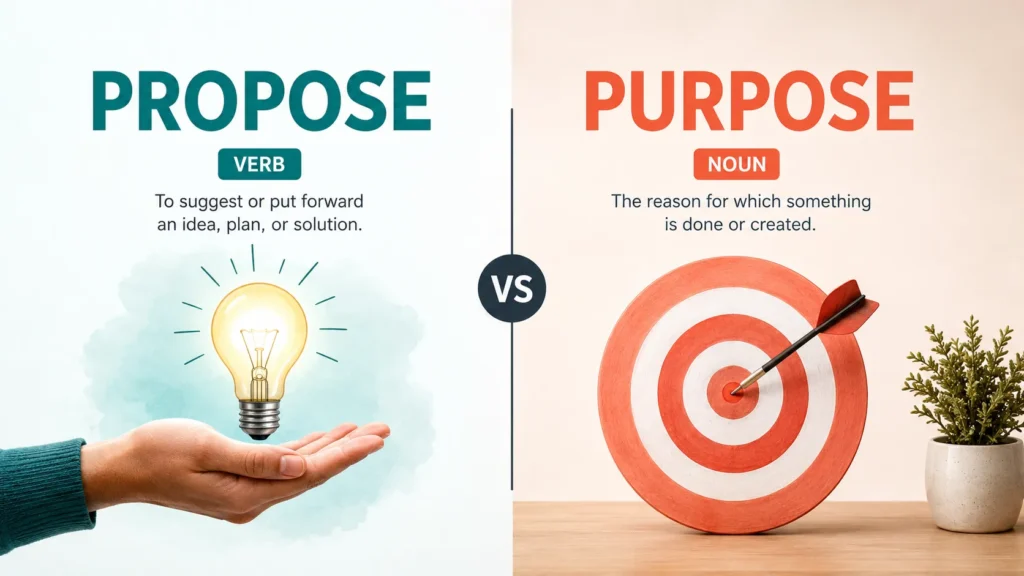
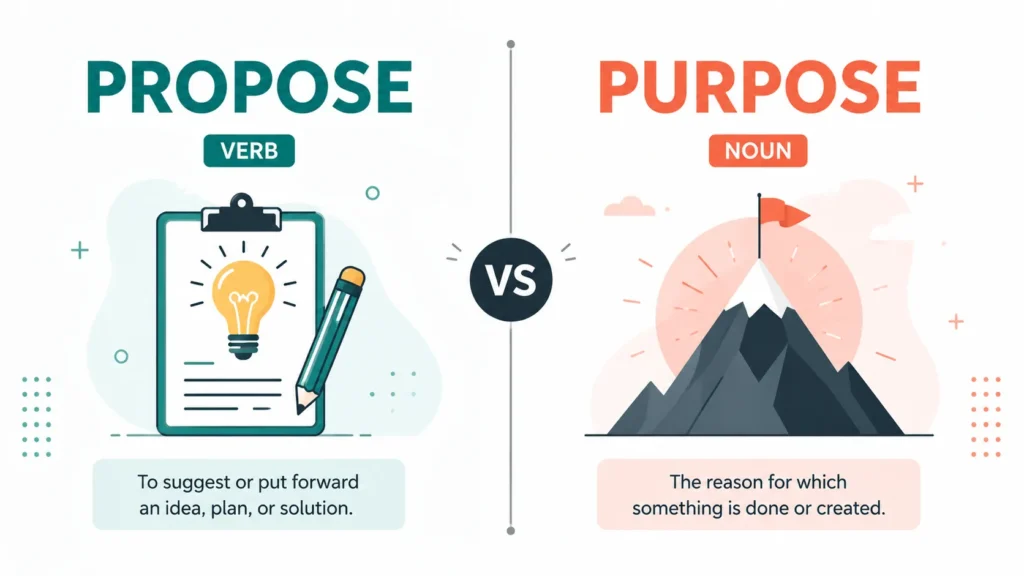
Propose is a Verb. It means to suggest, offer, or put forward an idea, plan, or marriage proposal. Purpose is a noun. It means the reason, goal, or intention behind something.
You propose a plan. That plan has a purpose.
1. What Does “Propose” Mean?
Propose is a verb rooted in the Latin proponere (“to put forward”). It describes an action — presenting something for others to consider, approve, or respond to.
Core meanings:
- To suggest a plan or idea — The committee proposed a new remote-work policy.
- To formally offer marriage — He proposed to her on a mountaintop at sunrise.
- To put forward a toast — The best man proposed a toast to the newlyweds.
- To intend or plan to do something — We propose to launch the product in Q3.
2. What Does “Purpose” Mean?
Purpose is a noun from the Old French porpos, meaning “intention.” It describes the reason behind an action — the “why” behind the “what.”
Core meanings:
- The reason something exists or is done — The purpose of this report is to summarize Q3 sales.
- A sense of personal drive or meaning — After changing careers, she finally felt a sense of purpose.
- The idiom “on purpose” (deliberately) — He left the light on on purpose.
- Rarely, an archaic verb meaning “to intend” — He purposed to travel the world.
3. Propose vs Purpose: Quick Comparison Table
| Propose | Purpose | |
| Part of speech | Verb | Noun (rarely a verb) |
| Meaning | To suggest, offer, or put forward | The reason, goal, or intention behind something |
| Pronunciation | pruh-POHZ | PUR-puhs |
| Answers the question | “What are you suggesting?” | “Why are you doing it?” |
| Example | “I propose we meet on Friday.” | “The purpose of the meeting is to review the budget.” |
| Related words | proposal, proposition, proposed | purposeful, purposely, purposeless |
| Marriage-related use | Yes | No |
4. Propose vs Purpose: The Key Grammatical Difference
- Propose = verb → an action someone does.
- Purpose = noun → a reason something has.
The swap test: Try substituting suggest into your sentence. If it fits, use propose. If reason or goal fits better, use purpose.
- I propose we reschedule. → “I suggest we reschedule.” ✅ → propose
- The purpose of the call is to reschedule. → “The suggest of the call…” ❌ → purpose
5. Propose vs Purpose in a Sentence
| Using “Propose” | Using “Purpose” |
| We propose expanding into the European market. | The purpose of the expansion is to increase revenue. |
| The paper proposes a new statistical model. | The purpose of the model is to predict outcomes accurately. |
| The lawyer proposed a settlement. | The purpose of the settlement was to avoid a lengthy trial. |
| I propose we watch a movie tonight. | What’s the purpose of watching that particular movie? |
| He finally proposed after five years together. | Their relationship gave his life new purpose. |
| She proposed a compromise. | The compromise served an important purpose for both sides. |
6. “Proposed” vs “Purposed”: The Mistake Almost Nobody Explains
- Proposed — the correct past tense of propose. Means something was suggested or offered. The new schedule was proposed by the HR team.
- Purposed — a rare, archaic past-tense form of the verb purpose (meaning “intended”). Rarely needed in modern writing. He purposed to finish the marathon, whatever it took. (technically correct, but outdated)
Rule Of Thumb: In 99% of modern writing, if you’re choosing between “proposed” and “purposed,” you want proposed.
❌ The propose of this document is to outline our strategy. ✅ The purpose of this document is to outline our strategy.
❌ I purpose that we start the project early. ✅ I propose that we start the project early.
7. Word Family: Proposal, Proposition, Purposeful, Purposely
From “propose”:
- Proposal (noun) — a formal plan put forward. She submitted a business proposal.
- Proposition (noun) — a suggestion or statement to be considered. He made an interesting proposition.
- Proposed (adjective/verb) — put forward for consideration. The proposed budget was rejected.
From “purpose”:
- Purposeful (adjective) — having a clear aim. She walked with purposeful strides.
- Purposely (adverb) — intentionally, deliberately. He purposely avoided the topic.
- Purposeless (adjective) — lacking direction. The meeting felt purposeless.
- Purpose-driven (adjective) — motivated by a clear goal. It’s a purpose-driven organization.
8. Origin and Etymology of Propose and Purpose
Both words trace back to the Latin prefix pro- (“forward”), which is why they look alike — but their paths diverged centuries ago:
- Propose comes from the Latin proponere (“to put forth”), passed through Old French proposer. It kept its identity as an action verb throughout its history.
- Purpose comes from the Old French porpos, derived from pourposer (“to intend”). Over time, English settled on using it almost exclusively as a noun.
So while both share a Latin ancestor meaning “to put forward,” English split them into two different grammatical jobs — one became the action (propose), the other the reason (purpose).
9. Propose vs Purpose in Business Writing
- The agency proposed a revised marketing budget for next quarter. (action taken)
- Our company’s purpose is to make renewable energy affordable. (reason/mission)
- The board will vote on the proposed merger next week.
- The purpose of the merger is to expand into new markets.
In business writing, propose usually appears in proposals, pitches, and recommendations, while purpose appears in mission statements, objectives, and rationale sections.
10. Propose vs Purpose in Academic and Legal Writing
- The study proposes a new framework for measuring employee engagement.
- The purpose of this experiment is to test the hypothesis under controlled conditions.
- The senator proposed an amendment to the housing bill.
- The purpose of the clause is to protect both parties in the event of a breach.
Academic papers typically propose theories, models, or methods, then state the purpose of the research in the introduction or abstract. Legal documents follow the same pattern: proposed amendments, stated purposes.
11. Propose vs Purpose in Everyday Conversation
- I propose we order Ppizza tonight instead of cooking.
- What’s the purpose of this meeting?
- She’s hoping he’ll propose before the year ends.
- Finding your purpose often takes time and self-reflection.
In casual speech, propose is a lighter, everyday way to suggest something, while purpose often shows up in reflective or personal conversations about goals and meaning.
12. “On Purpose” and Other Common Idioms
- On purpose — deliberately, intentionally. She left the door open on purpose to let fresh air in.
- Sense of purpose — a feeling of drive or meaning. After volunteering, he found a new sense of purpose.
- Purpose-built — designed for a specific reason. This is a purpose-built research facility.
- Propose a toast — to formally invite others to drink to something. He proposed a toast to the graduates.
None of these idioms swap the words — to propose and to propose a toast are not valid phrases, which is a useful check when in doubt.
13. Common Mistakes to Avoid
| ❌ Incorrect | ✅ Correct |
| The propose of this meeting is unclear. | The purpose of this meeting is unclear. |
| I propose we leave early. | I propose we leave early. |
| She purposed a new plan to the board. | She proposed a new plan to the board. |
| What is the propose of this tool? | What is the purpose of this tool? |
| He proposed of writing a novel someday. | He proposes to write a novel someday. |
14. Memory Tricks to Remember the Difference
- Propose → Points forward. Picture the “P” in propose as an arrow (→) — an action pushing an idea forward.
- Purpose → Pursues a goal. Picture purpose as a target (🎯) — the reason you’re aiming somewhere.
- Ring test: If you can picture someone getting down on one knee, it’s propose. Purpose never involves a ring.
- Swap test: If “suggest” fits, use propose. If “reason” or “goal” fits, use purpose.
15. Quick Quiz: Test Yourself
Fill in the blank with propose or purpose:
- What’s the ______ of this survey?
- I ______ we take a fifteen-minute break.
- He got down on one knee and ______ to her.
- The company’s ______ is to reduce plastic waste.
- The board will vote on the ______d merger next week.
- She lives with a strong sense of ______.
- They ______ a new pricing model for 2027.
- The ______ of the clause is to protect tenants.
Answers: 1. purpose · 2. propose · 3. proposed · 4. purpose · 5. propose(d) · 6. purpose · 7. propose(d) · 8. purpose
People Also Ask
Technically yes, but it’s archaic (e.g., “he purposed to travel”). Modern English favors intend or plan instead.
Propose is the verb — the action of suggesting something. Purpose is the noun — the reason behind that action.
Use proposed almost every time. Purposed is a rare, outdated form and should generally be avoided.
It means intentionally or deliberately — the opposite of “by accident.” She left the door open on purpose.
Use the swap test: “suggest” fits propose; “reason” or “goal” fits purpose.
Rarely. Style guides favor intend or plan over the verb form of purpose.
Conclusion
Propose and purpose may look alike, but they play completely different roles in a sentence: propose is the verb for suggesting or offering an idea, while purpose is the noun for the reason or goal behind it. The single most common real-world error — writing “purposed” when you mean “proposed” — is easy to avoid once you remember that proposed is almost always the correct choice in modern writing. Use the Swap test Whenever you’re unsure, and you’ll never confuse these two words again.