Passerby, Passersby, or Passerbyers? Here’s the Correct Plural (With Proof)
You’re writing a sentence about a crowd of strangers watching something happen on the street, and you freeze. Is it a group of passerbys? Passerbyers? Or passersby? All three feel a little wrong, which is exactly why so many careful writers stop and Google it.
Quick answer: The only correct plural of passerby is passersby. Passerbys and passerbyers are both nonstandard — neither appears in Merriam-Webster, Oxford, Cambridge, or Dictionary.com. The reason comes down to a specific rule about how English pluralizes compound nouns, which we’ll walk through below.
1. Quick Reference: Which Form Is Correct?
| Form | Status | Why |
| Passerby | Correct (singular) | One person who passes by |
| Passersby | Correct (plural) | The standard, dictionary-listed plural |
| Passers-by | Correct (older/British variant) | Same word, hyphenated style |
| Passerbys | Incorrect | Treats passerby like a simple noun (it isn’t) |
| Passerbyers | Incorrect | Adds a plural ending to a word that’s already been pluralized internally |
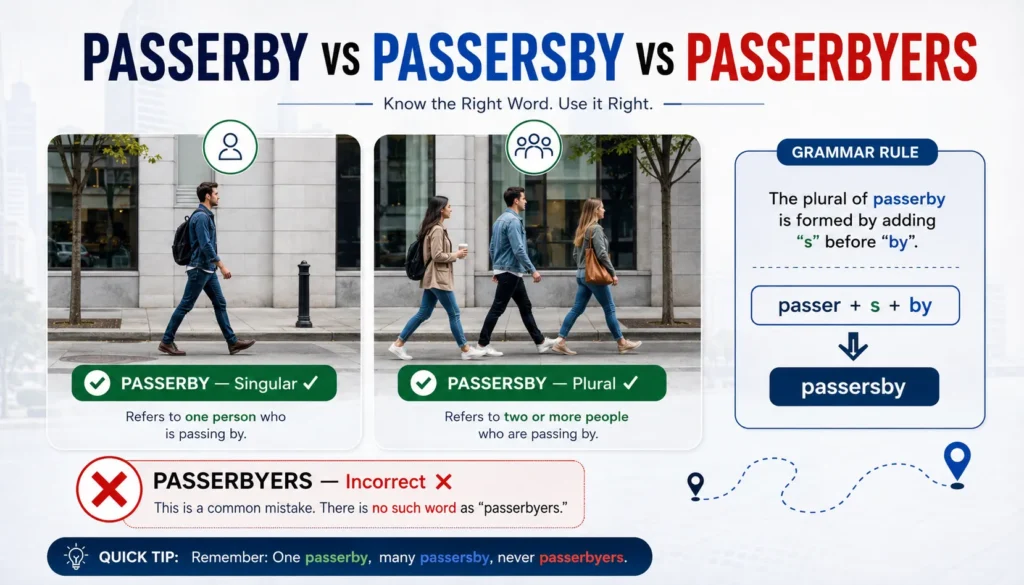
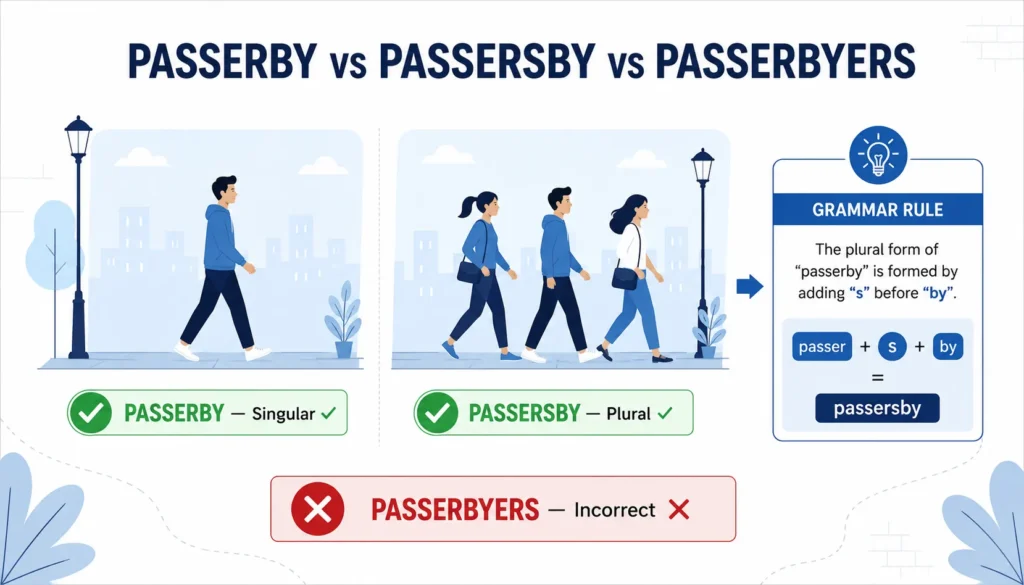
If you remember nothing else from this article, remember this: the “s” goes in the middle of the word, not at the end. Passer + s + by = passersby.
<a name=”what-it-means”></a>

2. What “Passerby” Actually Means
A passerby is a person who happens to be passing a particular place, usually by chance, and usually without being personally involved in whatever is going on there.
- A passerby called 911 after noticing smoke coming from the second floor.
- A lone passerby stopped to ask if we needed directions.
Pronunciation: singular /ˈpæs.ɚˌbaɪ/ (PASS-er-by); plural /ˌpæs.ɚzˈbaɪ/ (PASS-erz-by) — the plural “z” sound sits in the middle of the word, which is a useful thing to hear out loud if the spelling still feels unnatural.
Passerby functions only as a noun.
3. The Grammar Rule: Why “Passersby” Wins
- passer — a noun, meaning “one who passes”
- by — a preposition/adverb, meaning “alongside” or “past”
In linguistics, this kind of compound is called exocentric with a non-final head: the part of the word that actually carries the “noun-ness” (passer) isn’t the last part of the word (by). Most English compounds put the head noun last (a fire truck is a kind of truck), which is why we instinctively add “-s” to the end of most compounds (fire trucks). So the plural marker attaches to passer, not to the whole word:
passer + -s + by → passersby
This process is called internal pluralization (sometimes “internal inflection”), and English uses it consistently for a small, specific family of compound nouns where the head noun sits in the middle or at the front rather than at the end. That’s the entire rule. It isn’t an exception invented to confuse you — it’s the same pattern showing up every time.
<a name=”passerbyers-wrong”></a>
4. Why “Passerbyers” Feels Right but Isn’t
Passerbyers is a really understandable mistake, and it’s worth explaining why it happens rather than just labeling it wrong.
English speakers are trained on a huge number of words where “-er” or “-ers” marks a person who does something: Bake → Baker → Bakers, run → runner → runners, teach → teacher → teachers. When your brain sees “passerby” and reads it as “someone who passes by,” it wants to reach for that same “-er(s)” pattern, especially since by is the last syllable you hear.
The problem is that passerby already contains its “-er. Adding “-ers” on top of that, as in passerbyers, effectively pluralizes the agent suffix twice: once in “passer” and again in “-ers.” It’s the grammatical equivalent of saying “childrens” — piling a second plural marker onto a word that’s already carrying one.
- Several passerbyers called the police.
- Several passersby called the police.
No dictionary — Merriam-Webster, Oxford English Dictionary, Cambridge, or Dictionary.com — lists passerbyers as a word, in any variant spelling.
<a name=”etymology”></a>
5. Where the Word Comes From
This is the part most competing explainers skip, and it’s actually where the “why” of the spelling becomes clear.
According to the Oxford English Dictionary, the earliest recorded use of passer-by is from 1568, and Etymonline dates the compound to the 1560s, formed from the agent noun passer (from the verb pass, ultimately from Latin passus, “step” or “pace”) plus the adverb by. A related, older sense of “a traveler” had already existed in Middle English as passager, borrowed from Old French, before the pass + by compound took over.
For roughly three centuries the word was written as two words or hyphenated — passer by or passer-by — with the plural correspondingly written passers-by. The closed, unhyphenated spelling passerby (and its plural passersby) became standard later, as English gradually dropped hyphens from many long-established compounds (the same shift that turned to-day into today and e-mail into email).
So the “internal s” isn’t a random quirk — it’s a fossil of the era when the word was still written as two or three separate words, and pluralizing the noun in the middle was the only logical option.
<a name=”hyphen”></a>
6. Passer-By vs. Passerby: The Hyphen Question
Both the hyphenated and closed forms are considered correct today; the difference is mostly regional and stylistic rather than a matter of “right” and “wrong.”
| Style | Singular | Plural | Common in |
| Closed (modern) | passerby | passersby | American English; most current journalism and style guides, including AP |
| Hyphenated (traditional) | passer-by | passers-by | British English; older or more formal/literary writing |
If you’re writing for a US audience, passerby/passersby is the safer default. If you’re following a British house style or working with older source material, passer-by/passers-by is equally acceptable — just pick one spelling and use it consistently throughout the same document. What’s never acceptable in either style is passerbyers or passerbys.
<a name=”dictionaries”></a>
7. What the Dictionaries Actually Say
| Source | Singular listed | Plural listed | “Passerbyers” listed? |
| Merriam-Webster | passerby | passersby | No |
| Oxford English Dictionary | passer-by | passers-by | No |
| Cambridge Dictionary | passer-by | passers-by | No |
| Dictionary.com | passerby | passersby | No |
| AP Stylebook | passerby | passersby | No |
Every major English-language dictionary agrees on the same plural. When sources agree this consistently, it’s not really a live debate among grammarians — it’s a case of one correct form and two common typing mistakes.
<a name=”synonyms”></a>
8. Passerby vs. Bystander vs. Onlooker vs. Pedestrian
These words get used interchangeably, but they aren’t quite synonyms — the distinctions are genuinely useful for precise writing.
| Word | Core meaning | Implies involvement? |
| Passerby | Someone incidentally passing the location | No — often didn’t even notice the event |
| Bystander | Someone present at an event but not participating | Present and aware, but not acting |
| Onlooker | Someone actively watching something happen | Present, aware, and specifically watching |
| Pedestrian | Someone traveling on foot (a legal/traffic term) | Neutral — no relation to any event |
| Witness | Someone who saw something, often in a legal context | Present, aware, and able to report on it |
A useful test: if the person in your sentence didn’t notice whatever happened, “passerby” is usually the right word. If they stood and watched, “onlooker” or “bystander” fits better.
<a name=”examples”></a>
9. Passersby in Real Sentences
News and everyday writing:
- A passerby flagged down an ambulance after the collision.
- Several passersby helped move the fallen tree off the road.
- The buskers drew a small crowd of curious passersby.
- Police are asking any passersby who witnessed the incident to come forward.
Literary/descriptive writing:
- The old bookstore window caught the eye of every passerby who slowed down long enough to look.
- Passersby hurried home through the rain, heads down, umbrellas up.
Common errors, corrected:
- A crowd of passerbyers gathered to watch. → A crowd of passersby gathered to watch.
The passerbys didn’t stop. → The passersby didn’t stop.
<a name=”other-compounds”></a>
10. Other Compound Nouns That Break the Same “Rule”
Passersby isn’t a one-off oddity — it belongs to a small, recognizable family of English compounds where the head noun isn’t at the end, so the plural “-s” moves inward:
| Singular | Plural | Head noun |
| mother-in-law | mothers-in-law | mother |
| attorney general | attorneys general | attorney |
| editor-in-chief | editors-in-chief | editor |
| court-martial | courts-martial | court |
| notary public | notaries public | notary |
| looker-on | lookers-on | looker |
| passerby | passersby | passer |
Once you see the pattern across all of these, “passersby” stops looking like a weird exception and starts looking like exactly what it is — one example of a rule you already half-know from mothers-in-law.
<a name=”quiz”></a>
11. Quick Self-Test
Fill in the blank with the correct form:
- Three ______ stopped to help. (passerby/passersby / passerbyers)
- A lone ______ watched from across the street. (passerby/passersby)
- The mural attracts curious ______ every day. (passerbys / passersby)
Answers: 1. passersby — 2. passerby — 3. passersby
12. People Also Ask
No. It doesn’t appear in any major dictionary and is Considered A Nonstandard, incorrect pluralization of passerby.
Passersby (or passers-by in the hyphenated British style). The “s” is inserted after “passer,” not added to the end of the word.d
No — it’s a common misspelling, not an accepted variant. Style guides and dictionaries only recognize passersby.
Because passerby is a compound noun whose head noun (“passer”) isn’t the last element of the word. English pluralizes the head noun, so the “-s” goes in the middle: passer-s-by.
Both are correct. Passerby (closed, no hyphen) is standard in American English; passer-by (hyphenated) is more common in British and older/literary English.
A passerby is simply someone who happens to be passing the location, often without noticing anything unusual. A bystander is present and aware of an event but not participating in it.
Conclusion
- The only correct plural of passerby is passersby (or passers-by, hyphenated).
- Passerbys and passerbyers are both incorrect and appear in no major dictionary.
- The rule: in compound nouns where the head noun isn’t last, the plural “-s” goes on the head noun, not at the end of the word — the same pattern as mothers-in-law and attorneys general.