W Meaning in Text: What It Really Stands For
If you’ve ever gotten a text or comment that’s just “W” and nothing else, you’re not missing an inside joke — you’re looking at one of the most common pieces of internet slang today. People search “w meaning in text” because a single letter can carry real weight in a conversation, and getting it wrong (replying confused, or missing sarcasm) can feel awkward. This guide gives you the fast answer first, then every nuance: where it came from, how it changes by platform, when it’s sarcastic, and when you should avoid it entirely.
What Does “W” Mean in Text?
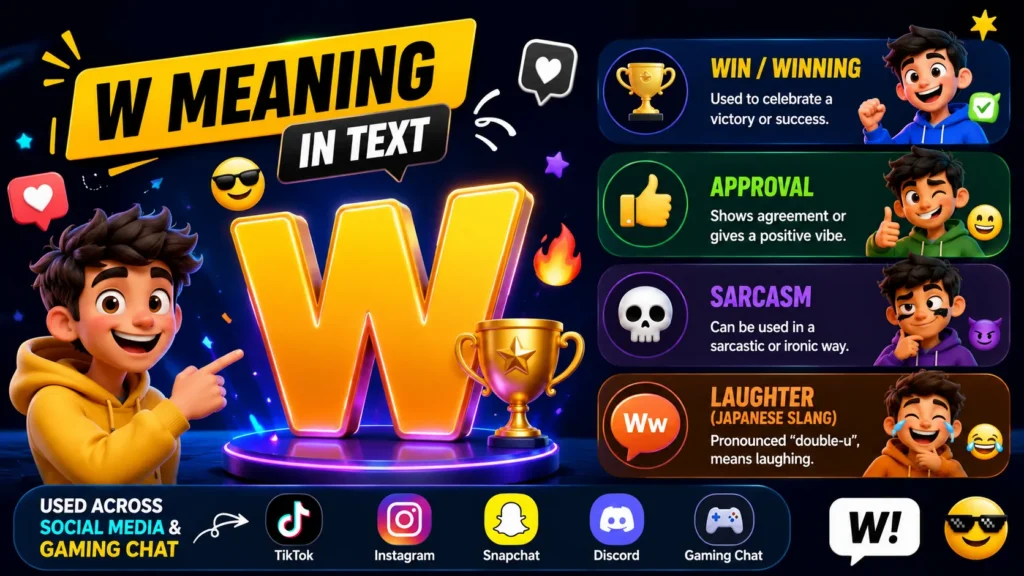
“W” is internet slang for “win.” It’s used to celebrate a success, agree with someone, or show approval — the one-letter version of saying “nice job” or “that’s awesome.” Its opposite is “L,” short for “loss.”
“Got the internship! ” → “W 🎉”
“This edit is actually insane” → “W content”
“Coach cancelled practice” → “W“
That’s the core meaning in nearly every case you’ll run into on texting and social apps.
Quick Meaning Summary
| Aspect | Detail |
| Most common meaning | Win/winning |
| Opposite term | L (loss) |
| Spoken version | “Dub” |
| Origin | Sports scoring → gaming chat → social media |
| Most common users | Gen Z, Gen Alpha, gamers, streamers |
| Tone | Casual, informal — avoid in professional writing |
| Other meanings | Laughter (Japanese slang), sarcasm, “with,” or technical terms (watt, west, work) |
Origin and History
The idea didn’t start in texting — it started on a scoreboard. Sports standings have used “W” for win and “L” for loss for decades, and that’s the root concept everything else borrowed from.
From there:
- Gaming chat picked it up first. In fast multiplayer matches, typing full sentences isn’t practical, so players dropped a quick “W” or “L” the moment a match ended — a text version of a scoreboard.
- Twitch and esports chat normalized it as a live reaction, alongside similar one-letter reactions like “F” (a mock-solemn nod to a loss).
- Twitter/X carried it into sports and pop-culture commentary, reacting to big plays or announcements in real time.
- TikTok and Instagram made it mainstream in the early 2020s — you no longer needed to be a gamer to understand or use it.
- Today it’s generation-spanning, common enough to occasionally show up in casual workplace chat, not just gaming and social apps.
Why Is “W” Popular?
Because it’s fast, expressive, and signals belonging. Typing one letter is quicker than typing “congratulations,” and using shared slang is a small social signal — it shows you’re plugged into the same online culture as the person you’re talking to. That same logic is why “lol,” “lmao,” and “fr” caught on: brevity plus community.
Real-World Usage: How People Actually Use “W”
“W” shows up in three main patterns:
- Standalone reaction — just “W” as a full reply
- Prefix/modifier — “W move,” “W take,” “W decision”
- Suffix/emphasis — “what a W,” “certified W,” “big W”
It can respond to something someone did (an achievement), something someone said (an opinion you agree with), or something that simply happened around you (good news, good luck).
Examples of “W” in Text
Celebrating an achievement
Friend: “I finally passed my driving test!” You: “Let’s gooo, huge W 🎉”
Group chat approval
“Pizza place is doing 2-for-1 tonight.” “W for the whole group.”
Gaming
“Clutched that 1v3.” “Certified W.”
Casual work chat
“Client signed off on the first draft, no notes.” “That’s a W, team.”
Sarcastic use
“Bro tried to parallel park for 10 minutes and hit the curb twice.” “Big W 💀”
“W” on Social Media: Platform-by-Platform Breakdown
| Platform | Typical Use |
| TikTok / Instagram comments | Praising a video, glow-up, or good decision — often just “W” alone |
| X (Twitter) | Reacting to sports plays, news, or viral moments in real time |
| Twitch / Discord | Fast chat reaction the instant something good happens in a stream or game |
| Snapchat / WhatsApp | Reacting to a friend’s personal news |
| Approving of an opinion, decision, or comment in a thread | |
| Dating apps | Complimenting a photo or bio — “W profile” — often flirtatiously |
Every Other Meaning of “W” (Beyond “Win”)
Most competing guides stop at “win.” Here’s what else “W” can mean depending on context:
- Laughter (Japanese internet slang): In Japanese texting and forums, “w” is short for warai (笑い), meaning “laugh” — functioning exactly like “lol.” Stacking letters (“wwww”) signals harder laughter, the same way “hahaha” does in English. This usage has nothing to do with win/loss and dates back to Japan’s 2channel forum culture.
- Sarcasm: A “W” paired with a 💀 emoji after an embarrassing story flips the meaning into mockery, not praise.
- Shorthand for “with”: An older, less common texting habit (“hanging w my friends,” “w/”).
- Technical, non-slang meanings: watt (unit of power), west (compass direction), work (physics), width (measurements), and tungsten (chemical symbol, from wolfram) — all standard outside of chat contexts.
Related Terms and Similar Meanings
| Term | Meaning |
| L | Loss — the direct opposite of W |
| Dub | The spoken version of “W” (“that’s a dub”) |
| Take the L / Take the W | Accepting a loss, or claiming a win, often jokingly |
| Ratio | A reply that outperforms the original post, implying the original is an “L” |
| F | Mock-solemn reaction to a loss (“press F to pay respects”) |
Types of “W”
| Type | Meaning | Example |
| Big W / Huge W | A major or life-changing win | “Got the scholarship — big W” |
| Common W | An expected, unsurprising win | “Aced another test — common W” |
| Rare W | An unexpected or lucky win | “Flight left on time — rare W” |
| Personal W | A small, private win | “Made my bed today — personal W” |
| L to W | Turning a bad situation into a good outcome | “Got rejected, found a better job — L to W” |
Common Misunderstandings
“W always means praise.” Not true — a sarcastic “W” (often paired with 💀) mocks a bad decision instead of celebrating it. Read the emoji and the story before assuming.
“W and dub are different things.” They’re not — “dub” is just how people say “W” out loud.
“W only means win.” In Japanese-language internet spaces, “w” means laughter and has a completely separate origin.
“It’s just for gamers.” It started in gaming and sports but is now mainstream slang across TikTok, Instagram, and even casual workplace chat.
Explore More: https://meaningoras.com/pk-meaning-in-text/
When NOT to Use “W”
Avoid it in:
- Formal emails or official documents
- Messages to teachers, professors, or people who likely won’t know the slang
- Serious conversations about grief or hardship, where a one-letter reaction can feel dismissive
- Client-facing professional communication, unless your workplace is genuinely casual
“Nice work,” “congrats,” or “that’s great” say the same thing with zero risk of being misread.
People Also Ask
It almost always means “Win” — a fast way to celebrate, agree, or show approval.
Usually, but not always. It can be sarcastic, especially paired with a 💀 emoji after an embarrassing story.
“L,” short for “loss.”
No — “dub” is simply “W” said out loud, since “W” sounds like “double-u.”
Yes — in Japanese internet slang, “w” means laughter (from warai). Outside slang, it can also mean watt, west, work, width, or tungsten.
Generally no. Save it for casual chats, gaming, and social media comments.
From sports win/loss records, adopted into gaming chat, then spread through Twitch, Twitter, and TikTok into everyday slang.
“Big W” signals a more significant win — a major achievement rather than a small everyday positive.
Conclusion
“W” is internet shorthand for “win” — a one-letter way to celebrate, agree, or show approval that grew out of sports scoring and gaming chat before spreading across every major social platform. Context is everything: the emoji, the story, and the platform tell you whether it’s genuine praise, playful sarcasm, or (in Japanese-language chats) simply laughter. Once you can read that context, you’ll never have to guess at a one-letter text again.