NTY Meaning in Text: What It Really Means (And When It’s Rude)
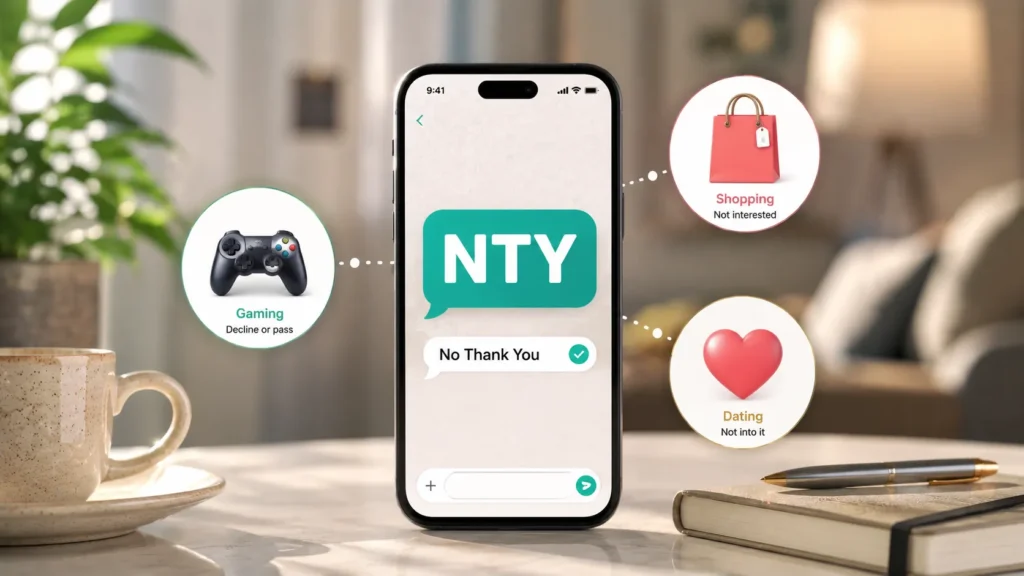
NTY stands for “No Thank You.” It’s a three-letter way to decline an offer, invitation, or request without typing the full phrase — a refusal that still tries to sound courteous, because the word “thank” is baked right into it.
That’s the literal definition. The part that actually trips people up is tone. Because NTY strips out punctuation, softening words, and the vocal warmth you’d hear if someone said “no, thank you!” out loud, the same three letters can land as perfectly polite in one chat and ice-cold in another. Reading NTY correctly means reading the relationship and the platform it showed up on — not just the letters themselves.
Quick Meaning Summary
| Full form | No Thank You |
| Category | Texting & internet slang (declining/refusal abbreviation) |
| Tone | Polite by default, can read as blunt or cold without context |
| First popularized | Early-to-mid 2000s, online gaming trade chats (RuneScape, MMORPGs) and SMS |
| Case sensitivity | None — “NTY” and “nty” mean the same thing |
| Most common platforms | Texting, Discord, gaming chat, Snapchat, Instagram DMs, marketplace apps (Etsy, Depop, Poshmark) |
| Opposite | TY / TYVM (thank you / thank you very much) |
| Commonly confused with | NT (“nice try”), NYT (The New York Times), nyt (goodnight) |
Origin and History of NTY
NTY’s roots trace back to two overlapping cultures: early-2000s SMS, where every character cost time (and sometimes money) on T9 keypads, and online gaming trade chats.
The gaming angle is the more interesting one. In MMORPGs like RuneScape, trading is transactional and constant — dozens of offers roll in per minute during busy trade windows. A player offering too little gold for an item gets a fast, no-hard-feelings “nty” and the negotiation moves on. There’s no room for a paragraph explaining why the offer’s too low; the abbreviation is the etiquette. That “speed over sentiment” habit spread outward from gaming into general chat slang, SMS, and eventually social apps, where it settled in as one of the standard texting acronyms alongside LOL, BRB, and TTYL.
Why Is NTY Still Popular in 2026?
A few things keep NTY in circulation instead of fading out like older slang:
- It’s the shortest polite decline available. “No, thanks” is 9 characters; NTY is 3.
- Marketplace and resale culture depends on it. Sellers on Etsy, Depop, Poshmark, and Facebook Marketplace field constant lowball offers, and NTY is the fastest way to close one out without an argument.
- Gaming and Discord communities never stopped using it. Trade, team-invite, and matchmaking chats still run on the same logic they did 20 years ago.
- It reads as “not rude” by default, unlike a flat “no,” which makes it low-risk in most casual settings.
How NTY Is Used, By Platform and Context
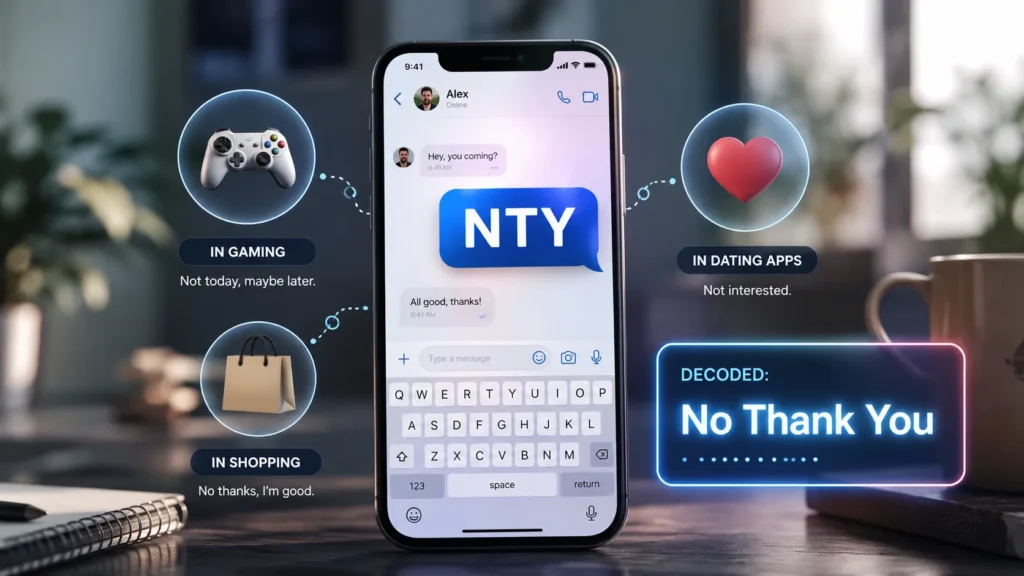
The definition doesn’t change across contexts — the social risk does. It runs on a gradient from “nobody blinks” to “this could come across as cold,” depending on where it’s sent and who it’s sent to.
NTY in Gaming Chat
Lowest-risk use case. In trade chats, party invites, or matchmaking, NTY is standard business language. Nobody reads it as cold because everyone’s operating on the same shorthand.
- “50g for the sword? nty, I need 100.”
- “nty, already full party.”
NTY on Marketplace and Resale Apps
Low-to-medium risk. Sellers on Etsy, Depop, Poshmark, and Facebook Marketplace use it constantly to decline lowball offers. It’s expected and rarely taken personally, though a follow-up like “nty, but I’d do $40” reads better than a bare “nty.”
- “Would you take $15 for this?” → “nty, firm on $25.”
NTY in Group Chats and Casual Texting
- Medium risk. Fine between people who already have an established rapport, since tone is filled in by the relationship rather than the words themselves.
- “Pizza Tonight?” → “nty, already ate lol”
NTY on Dating Apps
Higher risk. This is where NTY is most likely to sting. Without an existing relationship to soften it, a bare “nty” to an invitation can read as dismissive or even rude, since there’s no context to fall back on.
- “Want to grab coffee sometime?” → “nty” — technically polite, but often perceived as cold in this setting.
NTY in Professional Messages
Avoid. NTY is casual slang, so in an email to a boss, client, or coworker it reads as unprofessional regardless of intent. Spelling out “No, thank you” or “I’ll have to pass this time” is the safer move.
Real Examples of NTY in Conversation
- “Free samples at the front?” — “nty, just browsing”
- “Can you cover my shift Friday?” — “nty, already have plans, sorry!”
- “Want in on the group project chat?” — “nty I’m not taking that class”
- “$30 for the jacket?” — “nty, lowest I’ll go is $45”
Notice the pattern in the ones that land well: they’re either in a low-stakes context (gaming, resale) or paired with a small extra detail (“sorry!”, “already have plans”) that restores the warmth the bare acronym leaves out.
NTY on Social Media
On Instagram, TikTok, and Snapchat, NTY shows up most often in comments and DMs declining a collab, tag, or invite — the same core meaning, just in a public-facing space where tone reads even more literally. Adding an emoji (🙏, 😅) is a common way users soften it in these settings, since there’s no voice or body language to do that work for them.
Common Misunderstandings (NTY vs. NT vs. NYT)
NTY vs. NT: These are not the same. NT means “nice try” (used after someone attempts and fails at something, often in gaming), while NTY means “no thank you.” Mixing them up changes the meaning entirely.
NTY vs. NYT: All-caps NTY is sometimes a simple typo for NYT — The New York Times — especially on X/Twitter, where posts can’t be edited. Context usually makes it obvious: a link to an article or a headline mention points to NYT, not a refusal.
NTY vs. nyt: Lowercase “nyt” is unrelated slang for “good night,” typically used to bookend a conversation between close friends or partners before bed. It’s easy to mistype one for the other since they’re separated by a single letter.
Is NTY always polite? Not automatically. The word “thank” makes it technically courteous, but brevity alone can read as dismissive in contexts that expect more warmth — dating chats and first-time conversations especially.
Related Terms and Slang
- TY / TYVM — “thank you” / “thank you very much,” the positive counterpart to NTY
- NT — “nice try,” unrelated in meaning despite the similar letters
- TBNT — “thanks but no thanks,” a slightly longer, more emphatic version of NTY
- IDC — “I don’t care,” a blunter, less polite way to express indifference
- NP — “no problem,” used to accept or brush off an apology or thanks
Peple Als Ask
NTY means “No Thank You.” It’s used to decline an offer, invite, or request quickly and, in theory, politely.
Not inherently — it’s more neutral-to-polite by default. Whether it feels rude depends heavily on the relationship and platform: it’s normal in gaming and resale chats, but can come across as cold in dating apps or messages to someone you don’t know well.
No. NT means “nice try,” typically used after a failed attempt at something. NTY means “no thank you.” They’re easy to mix up because of how similar they look.
It’s best avoided. NTY is casual internet slang, so professional messages read better with the full phrase, like “No, thank you” or “I’ll pass on this one.”
Yes — “NTY” and “nty” mean the same thing. Case is just a style choice, not a meaning change.
It grew out of early-2000s SMS culture (where shorter messages saved time and money) and online gaming trade chats, where fast, no-explanation-needed refusals were the norm.
Add a small detail or softener — “nty, already have plans!” or an emoji — instead of sending the bare acronym on its own, especially with someone you don’t know well.
Conclusion
At its core, NTY is a simple three-letter way of saying “no, thank you” — but its social meaning shifts with context. In a gaming trade chat or a resale DM, it’s just efficient shorthand nobody thinks twice about. In a first message on a dating app, that same abbreviation can land as cold or dismissive. The letters never change; the relationship and platform around them do all the work of setting the tone. Once you know that, NTY stops being confusing and starts being just another tool in your texting vocabulary — alongside terms like TBNT, NT, and TY, worth knowing so you never misread one for another.