Serpent vs Snake: What’s the Real Difference? (Meaning, Bible & Symbolism Explained)
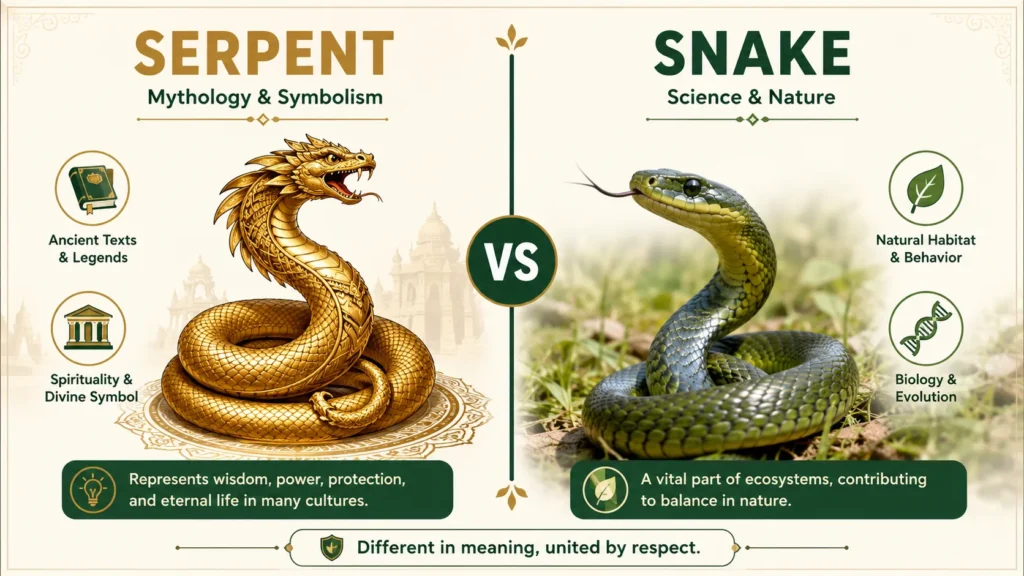
A serpent and a snake are the same animal. There is no biological difference — “serpent” is simply an older, more symbolic word for “snake,” used mainly in religion, mythology, and literature, while “snake” is the everyday, scientific term for the real animal.
People search for “serpent vs snake” for a simple reason: the words feel different even though they mean the same thing. One shows up in the Bible, in myths, and in poetry. The other shows up in your backyard, in biology class, and on the news. This guide breaks down exactly why that split happened, and how to use each word correctly.
What Does “Serpent vs Snake” Mean?
In short: every serpent is a snake, but “serpent” is the word we reach for when the snake needs to mean something more.
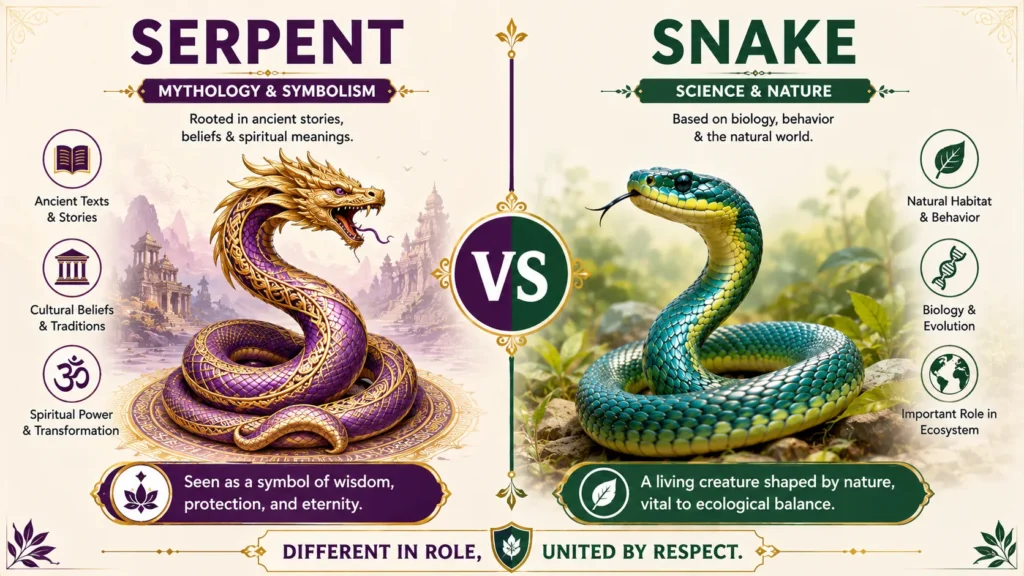
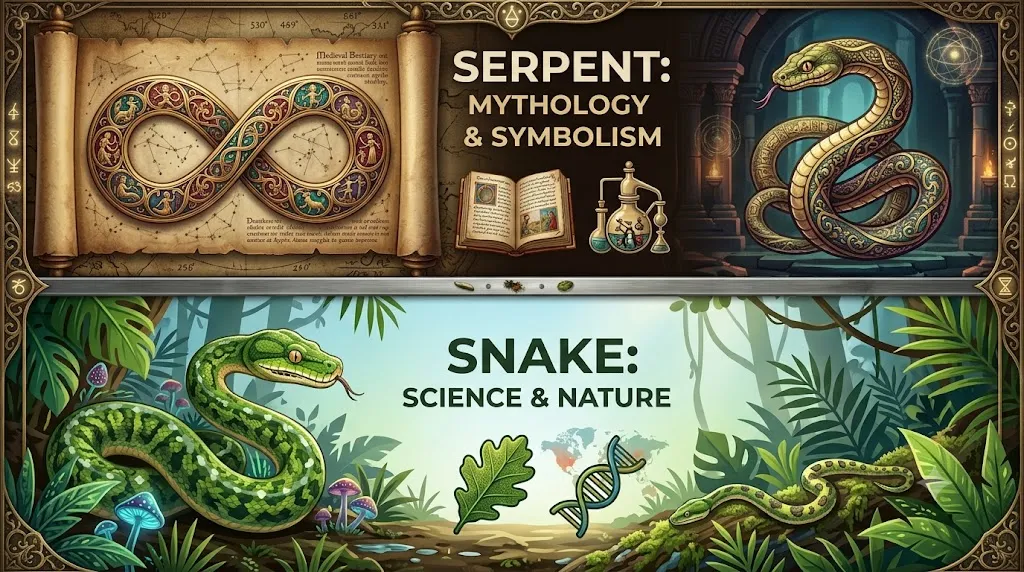
- Snake = the literal, physical, real-world animal (suborder Serpentes).
- Serpent = the same animal, described in a symbolic, religious, mythological, or literary way.
There is no separate species, family, or scientific category called “serpent.” The distinction lives entirely in tone and context, not zoology.
Quick Meaning Summary
| Snake | Serpent | |
| Meaning | The real, physical legless reptile | A symbolic or literary word for the same animal |
| Origin | Old English snaca, “to creep” | Latin serpens, “to crawl” |
| Used in | Science, news, everyday speech | Religion, mythology, poetry, fantasy |
| Tone | Neutral, factual | Formal, dramatic, symbolic |
| Scientific term? | Yes (suborder Serpentes) | No |
| Common phrase | “snake in the grass” | “the old serpent” (biblical) |
Origin and History
Snake comes from Old English snaca, tied to a root meaning “to crawl,” and always referred plainly to the physical animal.
Serpent comes from Latin serpens (“to crawl”), entering English through Old French around the 1300s — already carrying religious and moral meaning from early biblical translation. That’s the key difference: snake was born plain, while serpent arrived in English already loaded with symbolism.
By the 18th century, as biology became a formal science, snake was adopted as the standard classification word — cementing it as the neutral term, while serpent stayed behind in scripture, myth, and literature.
Is “Serpent” Still Used Today?
Yes, but narrowly. “Serpent” hasn’t disappeared — it’s simply specialized. You’ll still see it in:
- Bible translations and religious teaching
- Mythology, fantasy novels, and poetry
- Heraldry, tattoos, and symbolic art
- Formal or dramatic writing that wants extra weight
You almost never hear it in casual speech. Nobody says “there’s a serpent in my garden” — they say “there’s a snake in my garden.”
Real-World Usage
In practice, the two words split cleanly by context:
- Scientific / everyday: “The park ranger identified the snake as a harmless garter snake.”
- Religious / symbolic: “The serpent tempted Eve in the Garden of Eden.”
- News / casual: “A snake was found in the family’s garage.”
- Literary / fantasy: “A great serpent guarded the sunken temple.”
Examples of Serpent vs Snake in a Sentence
- A snake slithered across the trail. (real, factual)
- The serpent coiled around the ancient altar. (symbolic, dramatic)
- He’s such a snake for lying to his friends. (modern insult)
- The old serpent, called the Devil, deceived the whole world. (biblical register)
Biblical Meaning
In Genesis 3, the serpent tempts Eve to eat the forbidden fruit, making it one of the most influential symbols in Western religion and literature. Later Christian writing directly identifies this serpent with Satan, cementing “serpent” as a byword for deception, temptation, and hidden evil.
This is the single biggest reason “serpent” still feels heavier than “snake” today — its meaning in English was shaped by scripture before it was ever used casually.
Cultural Meaning
Serpent symbolism shifts dramatically depending on the culture:
- Ancient Egypt: The cobra-shaped Uraeus symbolized royal and divine protection, worn on pharaohs’ crowns.
- Ancient Greece: The serpent Python guarded the Oracle at Delphi; a serpent-wrapped staff became the Rod of Asclepius, the global symbol of medicine.
- Norse mythology: Jörmungandr, the Midgard Serpent, encircles the world and signals the coming of Ragnarök.
- Hinduism: The Nāga, half-human and half-serpent, represents protection, fertility, and spiritual power.
- Aztec Mythology: Quetzalcoatl, the “Feathered Serpent,” is one of the most important creation deities.
- Chinese culture: The snake is a zodiac sign linked to wisdom and intuition, not menace.
- Aboriginal Australian tradition: The Rainbow Serpent is a major creation figure tied to water and land.
Across cultures, one pattern holds: the serpent is rarely “just an animal.” It’s a stand-in for a bigger idea — temptation, protection, wisdom, or creation — and whether it’s hero or villain depends entirely on who’s telling the story.
Spiritual Meaning
Beyond organized religion, the serpent is widely used as a spiritual symbol of transformation and renewal — largely because snakes shed their skin. In many spiritual traditions, seeing or dreaming of a serpent is interpreted as a sign of change, hidden knowledge, or a warning to pay attention to something being concealed. This meaning is cultural and symbolic, not scientific, and interpretations vary widely by belief system.
Symbolism and Interpretations
Put together, “serpent” carries a cluster of recurring symbolic meanings across religion, myth, and art:
- Temptation and deception (Genesis, Christian tradition)
- Wisdom and healing (Rod of Asclepius, Nāga)
- Protection and authority (Uraeus, Rainbow Serpent)
- Chaos and fate (Jörmungandr, Roman omens)
- Creation and renewal (Quetzalcoatl, skin-shedding symbolism)
“Snake,” by contrast, carries almost none of this baggage — it’s the neutral, descriptive word.
Serpent Symbolism in Tattoos
Serpent and snake tattoos are among the most popular symbolic tattoo designs, and the word choice matters even here. A “serpent tattoo” typically signals a design rooted in mythology, religion, or classical art (think Medusa, biblical imagery, or a serpent-and-staff medical symbol), while a realistic snake tattoo usually emphasizes the animal itself — its pattern, species, or personal meaning to the wearer. Common tattoo interpretations include transformation, protection, temptation, and rebirth, drawing directly from the cultural meanings above.
Common Misunderstandings
- “Serpents are a different species from snakes.” False — there’s no biological distinction at all.
- “Serpent always means evil.” Not true globally — many cultures (Hindu, Aztec, Egyptian, Aboriginal Australian) treat the serpent as a protector or creator, not a villain.
- “Serpent is just an old-fashioned way to say snake.” Partly true, but incomplete — it’s not obsolete, it’s specialized for religious, mythological, and literary contexts.
- “Using ‘serpent’ sounds smarter.” In casual writing, it usually sounds like a fairy tale rather than a real report — save it for the right context.
Related Terms and Similar Meanings
- Viper — a venomous snake family member (Viperidae), like rattlesnakes and adders.
- Python — a large, non-venomous constrictor snake.
- Cobra — a venomous, hood-displaying snake in the Elapidae family.
- Adder — a common name for certain European vipers.
- Asp — a historical/literary term for small venomous snakes, famously tied to Cleopatra.
- Sea serpent — a legendary, giant sea-dwelling snake-like creature from maritime folklore, not a real species.
People Also Ask
Yes. There’s no biological difference — “Serpent” is just a more formal, symbolic word for the same animal science calls a snake.
Because the word “serpent” entered English through Latin and French translation already carrying moral and religious weight, making it the traditional term for the tempter in Genesis.
No. Biologists classify these animals in the suborder Serpentes, but the actual working term in science is always “snake.”
No. While Christian tradition links it to temptation and Satan, many other cultures — Hindu, Aztec, Egyptian, and Aboriginal Australian traditions among them — treat the serpent as a symbol of protection, wisdom, or creation.
Use “snake” for anything factual, scientific, or everyday. Use “serpent” when you want symbolism, drama, or a religious/mythological tone
Conclusion
A serpent and a snake are the same creature wearing two different outfits. “Snake” is the word of science, nature, and everyday conversation — plain and precise. “Serpent” is the word of scripture, myth, and story — older, heavier, and shaped by centuries of symbolism from the Garden of Eden to the Aztec empire. Once you understand where each word comes from, choosing between them is no longer a guessing game — it’s simply a matter of what your sentence needs to do.