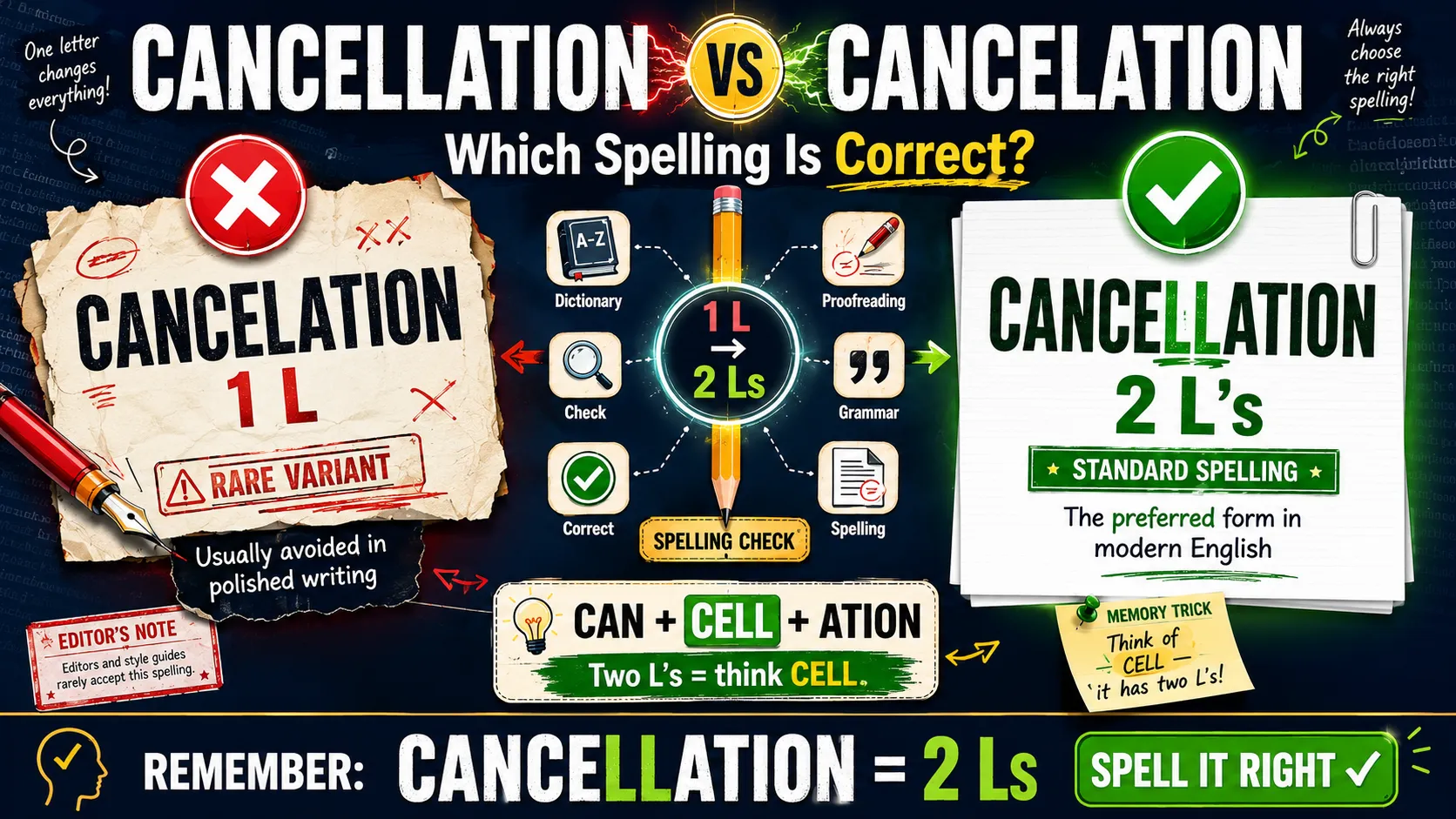
Cancellation vs Cancelation: Which Spelling Is Actually Correct?
Cancellation (two L’s) is the correct and standard spelling in both American and British English. Cancelation (one L) is a rare, chiefly American variant that most dictionaries list as secondary — and it’s the one spellcheckers, editors, and readers will flag as a mistake.
If you’ve ever paused mid-sentence wondering whether to type one L or two, you’re not alone. The good news is that the answer is simple and there’s no real ambiguity once you understand why the exception exists. This guide walks through the dictionary data, the style guide consensus, the linguistic history, and the practical rule you can rely on every time you write this word.
What Is the Difference Between Cancellation and Cancelation?
The only difference is one letter — a single “l” versus a double “l.” Both spellings refer to the same noun: the act of canceling something.
This is important to understand because some people assume that spelling variants like this must carry some subtle difference in tone or formality, similar to how “okay” and “OK” might feel slightly different in context. That’s not the case here. The single-L form isn’t a more casual synonym or a shorthand; it’s simply a spelling that fell out of favor and never became standard, even though it still shows up occasionally in casual American writing, marketing copy, and text generated without careful proofreading.
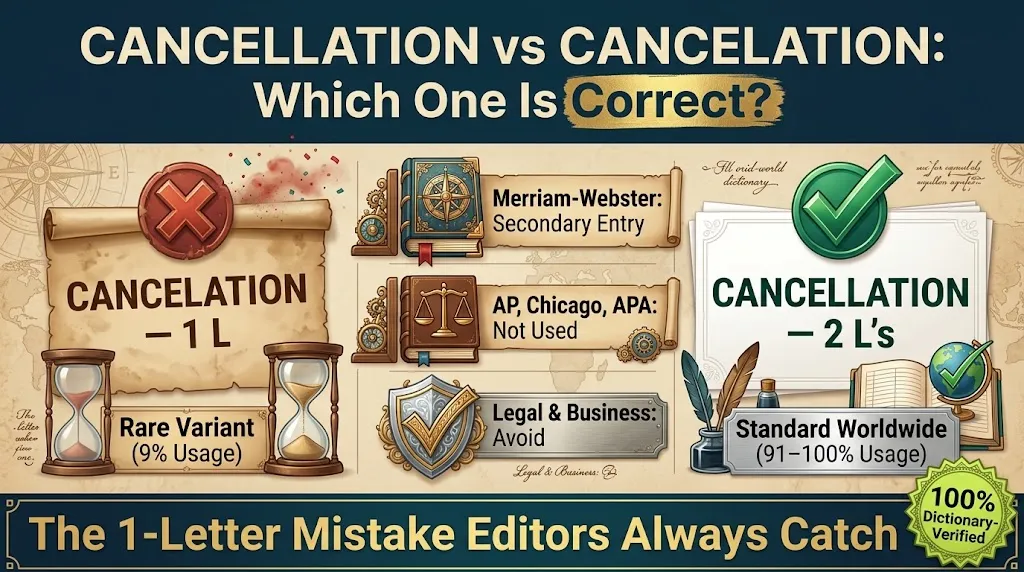
Cancellation vs Cancelation: Key Differences at a Glance
| Feature | Cancellation | Cancelation |
| Letter count | Two L’s | One L |
| US English | Standard (~91% usage) | Rare variant (~9%) |
| UK / AU / NZ / Canada / India English | Standard (93–100%) | Almost never used |
| Merriam-Webster | Main entry | Listed as a secondary variant |
| Oxford Dictionary | Standard spelling | Not a headword |
| Cambridge Dictionary | Standard spelling | Not listed |
| AP Stylebook | Used in all contexts | Not used |
| Legal / academic / business writing | Correct | Avoid |
| Spellcheck | Passes | Often flagged |
The table above summarizes what corpus data and dictionary entries consistently show: cancellation dominates by an overwhelming margin in every English-speaking region, and the gap isn’t close. Even in American English, where you might expect more tolerance for the single-L form given the general American tendency to simplify doubled consonants, cancellation still accounts for the vast majority of usage in edited, professional text
Which Spelling Is Correct — Cancellation or Cancelation?
Cancellation is correct in every major English-speaking country and every formal style guide.
This distinction matters because a lot of people approach this word assuming it must work like the classic American-versus-British spelling pairs they already know. With those pairs — color/colour, organize/organise, center/centre — both spellings are fully correct within their respective dialects, and using the “wrong” one is a matter of regional convention rather than an error. Cancellation and cancelation don’t work that way. There is no country, publication, or style guide that treats cancelation as the preferred or default spelling. It exists only as a secondary, less-common variant that a handful of American dictionaries acknowledge because it does appear in the wild — but acknowledging that a spelling exists is different from endorsing it as correct usage.
Why Is Cancellation Spelled With Two L’s?
Cancellation comes from the French and Latin root cancellare, entering English already spelled with two L’s — long before American spelling reforms simplified other words. It follows the double-consonant pattern used when adding “-ation” to certain root words, and it never went through the same suffix-simplification process that shortened words like traveling or labeled.
The verb forms really do follow the doubling-consonant suffix rule, and that rule really does differ between American and British English. But “cancellation” isn’t built by taking the verb “cancel” and adding a suffix in modern English — it arrived as a fully formed noun from French, which itself inherited it from Latin. Because it entered the language as a complete unit rather than being assembled through an English suffixation process, it was never subject to the same later simplification that reshaped words actually built through that process.
Is Cancelation a Real Word?
Yes, technically — some American dictionaries list cancelation as a valid alternate spelling. But being listed as a variant isn’t the same as being correct or expected. In professional, business, legal, or academic writing, cancelation will read as an error to most readers and editors.
It’s worth being precise about what “listed as a variant” actually means in a dictionary. Major dictionaries include secondary spellings not because they endorse them, but because their job is to document how language is actually used, including uncommon or nonstandard forms that appear with enough frequency to be worth noting. A secondary entry typically comes with implicit or explicit signals — appearing after the main entry, sometimes marked “also” or “variant of” — that tell you it’s not the recommended spelling.
American English vs British English: The Real Rule
American English usually drops the extra letter when adding a suffix — traveled, labeled, modeling. British English keeps the double letter — travelled, labelled, modelling.
This is genuinely one of the trickier corners of English spelling because the rule that predicts traveled vs travelled is a real, productive rule — and most fluent writers absorb it intuitively without ever studying it explicitly. The trouble is that intuition trained on one word family (cancel → canceled/cancelling) doesn’t automatically transfer to a related but structurally different word (cancellation), and English offers no visual cue in the spelling itself to warn you that the rule doesn’t apply. The result is that even careful, well-educated writers sometimes second-guess themselves on this specific word, because it genuinely looks like it should follow the same doubling logic as its verb cousins — and in almost every comparable case, it would.
What Dictionaries Say About Cancellation and Cancelation
| Source | Preferred Spelling | Notes |
| Merriam-Webster | Cancellation | Cancelation listed as rare variant |
| Oxford English Dictionary | Cancellation | Standard in British English |
| Cambridge Dictionary | Cancellation | No separate entry for cancelation |
Across the board, the major English dictionaries — American and British alike — converge on cancellation as the headword. Merriam-Webster, the most commonly cited American dictionary, does acknowledge cancelation but frames it as the less common form. British-based references like Oxford and Cambridge don’t feature cancelation as an entry at all, which reflects how rarely it appears in British, Australian, Canadian, or other Commonwealth English.
What Style Guides Say (AP, Chicago, APA)
| Style Guide | Preferred Spelling |
| AP Stylebook | Cancellation |
| Chicago Manual of Style | Cancellation |
| APA Style | Cancellation |
Even American, US-focused style guides converge on the double-L spelling for the noun — unlike canceled/cancelled, where AP explicitly recommends the single-L American form for the verb.
This convergence is worth dwelling on because these three style guides don’t always agree with each other, and they represent very different domains of writing — journalism, general publishing, and academic/scientific writing respectively. When style guides that otherwise diverge on plenty of conventions all land on the same spelling for a word, that’s about as strong a signal of consensus as you’ll find in English usage. If you’re writing for publication in any of these contexts, or simply want to match the expectations of professional editors, cancellation is the safe and correct choice without exception.
The Cancel Word Family: Canceled, Cancelled, Canceling, Cancelling
| Word | American English | British/Australian English |
| Verb (present) | cancel | cancel |
| Past tense | canceled | cancelled |
| Present participle | canceling | cancelling |
| Person who cancels | canceler | canceller |
| Adjective | cancelable | cancellable |
| Noun | cancellation | cancellation |
Every row except the noun follows the “American English drops the extra L” pattern. The noun is the one exception — always double it.
Seeing the whole word family laid out side by side makes the exception much easier to remember. Notice that five of the six rows genuinely differ by dialect — this is the normal, expected pattern that shows up across dozens of similar verbs in English (modeled/modelled, fueled/fuelled, signaled/signalled, and so on). Once you see cancellation grouped with its family and visibly breaking the pattern, it’s much easier to remember going forward that this one word doesn’t follow the dialect split you’d otherwise expect.
The Syllable Stress Rule Explained
- Stress on the syllable right before the suffix → the consonant doubles: re-MIT → remitted, remitting.
- Stress earlier in the word → the consonant usually stays single: ED-it → edited, editing.
This stress-based doubling rule is one of the more reliable patterns in English spelling, and it’s worth understanding because it explains a lot of seemingly random doubling decisions across the language. Compare permit (stress on the second syllable, per-MIT) with benefit (stress on the first syllable, BEN-e-fit): “permitted” doubles the consonant, while “benefited” typically doesn’t, at least in American English. Applying this same logic to “cancel,” which stresses the first syllable, correctly predicts that American English keeps a single L in canceled and canceling. It’s a separate word with a separate history, even though it shares a root and a meaning with the verb.
History and Origin of the Word Cancellation
Cancellation entered English through Latin cancellare (to cross out, as with lattice-like marks) via French, already spelled with two L’s.
The Latin root cancellare is itself related to cancelli, meaning “lattice” or “crossbars” — the same root that gives us the English word “chancel,” referring to the lattice-screened area near a church altar, and even distantly connects to “cancel” in its original literal sense of marking something out with crossed lines, as you might cross out an error on a page. The word traveled from Latin into French and from French into English well before American English existed as a distinct variety. Noah Webster’s 19th-century spelling reforms — the changes that gave American English color instead of colour, center instead of centre, and traveled instead of travelled — targeted specific patterns and specific words, largely based on simplifying spellings that Webster considered unnecessarily complex or overly beholden to French and Latin convention. Cancellation, already established with a fixed spelling and not derived through an English suffixation process, simply wasn’t part of that reform wave, which is a large part of why it survived unchanged on both sides of the Atlantic.
Cancellation in Real-World Use (Travel, Insurance, Subscriptions, Legal)
- Flight cancellation — airline-issued refunds and delay policies
- Subscription/SaaS cancellation — account cancellation, no cancellation fee
- Insurance cancellation — policy terminated before natural expiration
- Event cancellation — venue or show cancellations
- Legal cancellation — contract cancellation clauses
- Technical uses — noise cancellation, postal cancellation, mathematical cancellation
The word shows up constantly across industries that deal with plans falling through, and in every one of those industries, cancellation is the spelling you’ll see in official documentation. Airlines publish cancellation policies and cancellation fee schedules. Software companies write cancellation flows into their terms of service and design “cancel subscription” buttons that trigger a cancellation confirmation email. Event organizers and ticketing platforms post cancellation and refund policies that customers rely on when deciding whether to book. Even outside of commercial contexts, the word appears in more technical senses: noise-cancellation technology in headphones, postal cancellation marks stamped on envelopes, and mathematical cancellation, where common factors or terms cancel out of an equation. In every one of these domains, style consistency matters, and the consistent choice across all of them is the double-L spelling.
Cancellation vs Rescission: The Legal Difference
In contract law, cancellation ends a contract’s future performance, often due to breach. Rescission voids the contract entirely and restores both parties to their original position. The two terms are related but not interchangeable.
The parties generally keep whatever benefits they already exchanged before the cancellation took effect. If you’re drafting or reviewing legal documents, using the precise term matters, and getting the spelling of “cancellation” right is a small but real part of presenting that document as professionally drafted.
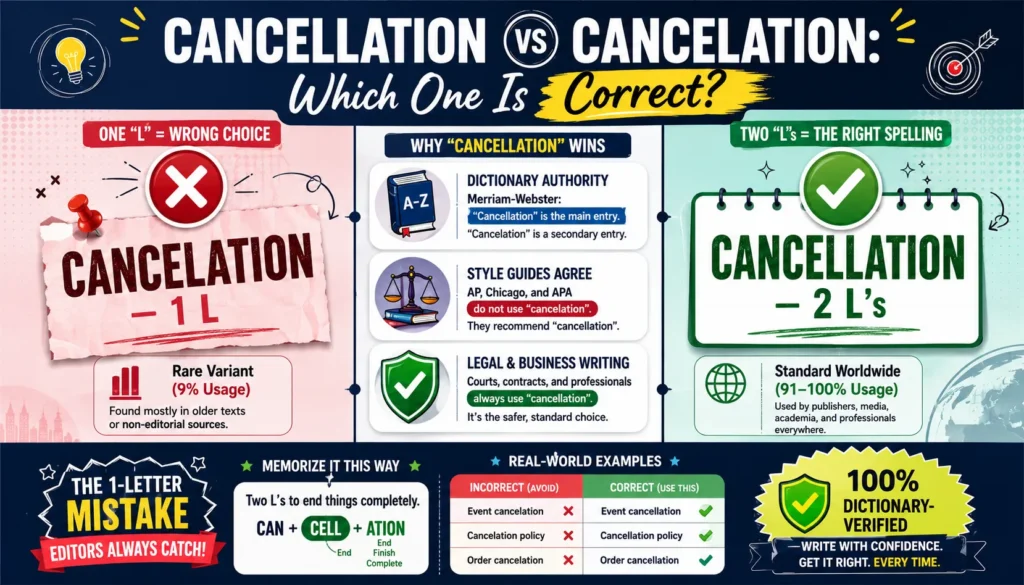
Common Mistakes to Avoid When Spelling Cancellation
- Applying the verb rule (“canceled,” one L) to the noun
- Mixing spellings within the same document
- Trusting autocomplete or AI tools over dictionaries
- Assuming British English is the only “correct” dialect for this word
The first mistake is by far the most common, and it stems directly from the pattern discussed earlier: because “canceled” correctly drops the second L in American English, it feels natural to assume the same logic applies to “cancellation.” It doesn’t, and catching yourself making this substitution is the single most useful habit you can build if this word trips you up regularlyEven if you occasionally use cancelation without anyone flagging it as wrong, switching between the two spellings within one document reads as careless and undermines the professionalism of the whole piece. The third mistake reflects a broader issue: autocomplete, predictive text, and even some AI writing tools can introduce inconsistent spelling, especially when trained on informal text where both variants appear. Cross-checking against an actual dictionary entry is a more reliable safeguard than trusting software defaults. The fourth mistake is a misconception rather than a typo — some writers assume that because this looks like a US/UK spelling pair, the “British” double-L version must be the alternative rather than the standard, when in fact it’s standard everywhere.
Explore More: https://meaningoras.com/kick-rocks-meaning/
Quick Rule to Remember: Cancellation vs Cancelation
- Verb forms (canceled/cancelled, canceling/cancelling) — American uses one L, British uses two.
- Noun (cancellation) — always two L’s, no dialect exception.
If you only take one thing away from this article, let it be this simple mnemonic: the verb splits by dialect, the noun doesn’t. Whenever you’re unsure, ask yourself whether you’re writing the action word (“I canceled my appointment”) or the noun describing the event or process (“the cancellation was unexpected”). If it’s the noun, two L’s, every time, everywhere.
People Also Ask
It exists as a rarely used American variant, but “cancellation” is the correct and standard spelling.
It’s occasionally seen in American English only — not used in British, Australian, Canadian, or Indian English.
Because it comes from an older French/Latin root rather than being built by adding a suffix to “cancel,” so it never went through the American spelling-simplification process.
Q4 Do canceled and cancelled follow the same rule as cancellation and cancelation?
No — canceled/canceling genuinely differ by dialect. Cancellation is spelled with two L’s in both dialects; there’s no standard “American” one-L version.
Cancellation — universally, to stay consistent across regions.
Most modern spellcheckers and grammar tools will flag it or suggest “cancellation.”
Conclusion
Use cancellation. It’s correct in American, British, and Australian English, and in every formal style guide — contracts, policies, journalism, and academic writing. Cancelation survives only as a rare footnote in a few American dictionaries and will read as a mistake to nearly every reader, editor, and spellchecker.
The next time you’re drafting a cancellation policy, writing a customer email about a canceled order, or just proofreading a document before it goes out, you now have a reliable shortcut: the verb forms follow the familiar American-vs-British pattern already know, but the noun never.